
When to Stop Swaddling Baby (AAP Guidelines): 5 Signs & 3 Safe Transition Tips

That snug swaddle is your little one’s secret to a good night’s sleep (and yours too!). It mimics the warm embrace of the womb, silences those startling Moro reflexes, and helps that tiny wiggly creature.
But suddenly, something shifts.
Maybe it’s 3 AM and you’re jolted awake by a rustling sound, only to find your baby squirming, wriggling, and fighting against the swaddle like a little fish trying to free its arms. Or maybe it’s during tummy time when he/she lifts his/her head, kick their legs, and begin tilting to one side. That’s when it hits you, your baby is trying to roll over.
And then comes the nagging question that sends your heart racing: “When should I stop swaddling baby??”
You should stop swaddling baby as soon as they show signs of attempting to roll over which can happen as early as 2 months old. The American Academy of Pediatrics (AAP) recommends stopping swaddling once a baby begins trying to roll. Red Nose Australia advises ceasing swaddling when a baby shows signs of rolling or reaches 3 months of age, whichever comes first. Continuing to swaddle a rolling baby increases the risk of suffocation and SIDS.
That sounds simple enough but putting it into practice feels anything but. How do you know for sure they’re “trying”? How do you make the transition without destroying your baby’s safe sleep (and your sanity)? And what happens when the dreaded 4-month sleep regression hits at the exact same time?
Take a deep breath. This article will walk you through everything: the 5 unmistakable signs that it’s time to stop swaddling baby, three proven transition methods that actually work, a practical product comparison to save you money, and real strategies to survive the transition with your sanity intact.
You are not alone in this. Let’s figure it out together.

Why You Need to Stop Swaddling Baby: The Safety Risks
You might be thinking: “But my baby sleeps so well in the swaddle. Why fix what isn’t broken?” This isn’t just about your baby “growing out” of it, it’s about life-saving safety.
The SIDS and Suffocation Risk
This is the most critical reason. A swaddled baby who rolls onto their stomach faces a dramatically increased risk of SIDS (Sudden Infant Death Syndrome) and SUID (Sudden Unexpected Infant Death). Your baby needs free arms to push up, lift their head, or readjust their sleeping position.
The data is sobering: a major meta-analysis found that when swaddled infants are placed on their stomachs to sleep, the risk of SIDS is nearly 13 times higher compared to unswaddled infants sleeping on their backs.
Think about that number for a moment.
Over 3,500 infants die each year in the United States from sleep-related causes, many of which are entirely preventable. That’s why the AAP emphasizes this so strongly: the moment your baby attempts to roll, the swaddle must go.
Hip Development Concerns
Wrapping too tightly can restrict the natural development of your baby’s hip joints. A proper swaddle should leave enough room for your baby’s legs to bend naturally at the hips and knees. Think “frog legs,” not “soldier at attention.”
Overheating Risks
Over-bundling or using heavy, thick swaddles can cause your baby to overheat, and overheating is a known risk factor for SIDS. You definitely don’t want your little one sweating through the night or worse.
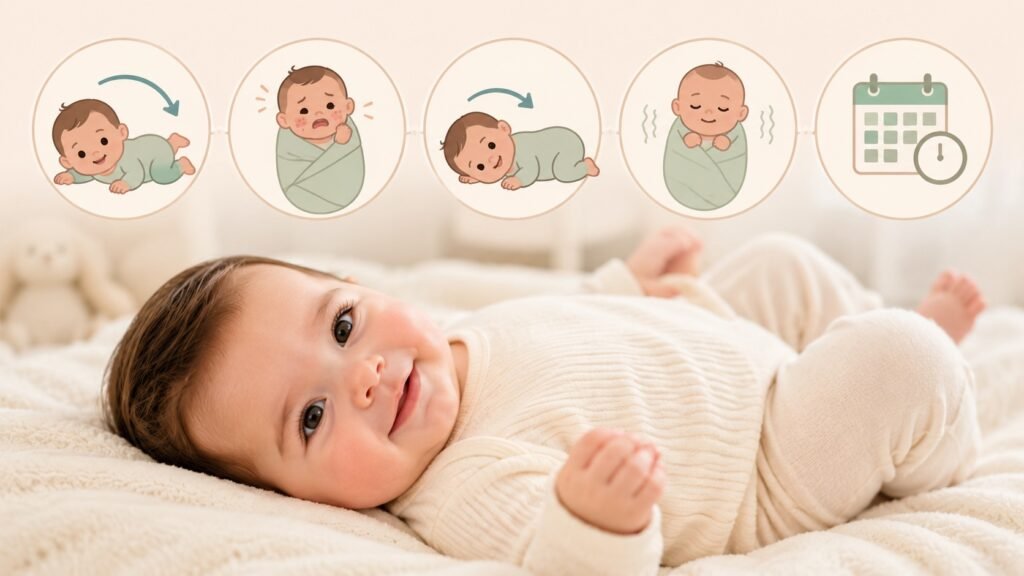
When to Stop Swaddling Baby: Official Guidelines from Leading Authorities
Different organizations phrase it slightly differently, but the core message is the same. Here’s a clear breakdown so you know exactly who says what.
The American Academy of Pediatrics (AAP)
American Academy of Pediatrics (AAP) advises, stop swaddling as soon as your baby shows signs of attempting to roll over. For some babies, this can happen as early as 2 months old. The AAP also explicitly recommends against using weighted swaddles, as they can restrict movement and breathing.
Red Nose Australia
Red Nose Australia recommends, stop swaddling baby when your baby shows signs of starting to roll, OR when they reach 3 months of age, whichever comes first. Once they can roll, they absolutely must have their arms free to reposition themselves safely.
The NHS (UK) and The Lullaby Trust
The NHS recommends stopping swaddling once your baby shows signs of rolling, which typically happens between 4 and 6 months. They also highlight the risks of overheating and hip dysplasia if swaddling continues for too long.
Comparison Table: Guidelines at a Glance
| Organization | When to Stop Swaddling | Key Notes |
|---|---|---|
| AAP | Stop swaddling baby when they begin trying to roll (as early as 2 months) | No weighted swaddles |
| Red Nose | Signs of rolling OR 3 months (whichever comes first) | Arms must be free to roll safely |
| NHS | When signs of rolling appear (usually 4 to 6 months) | Watch for overheating & hip health |
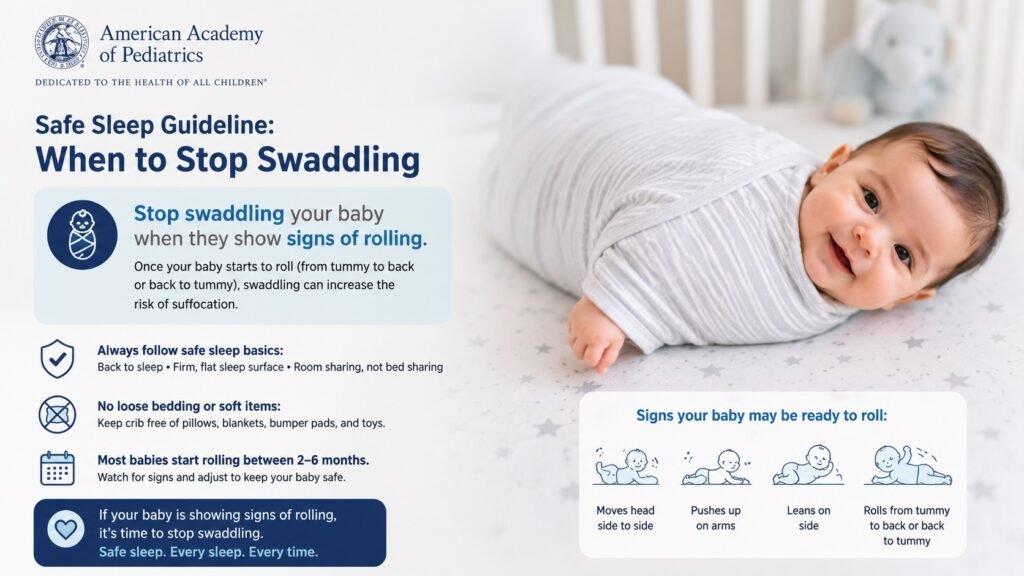
5 Key Signs Your Baby Is Ready to Stop Swaddling
Instead of obsessing over the calendar, watch your baby. They will give you clear signals. Here are the five most definitive signs:
Sign #1: Attempting to Roll Over (The Big One!)
This is your number one red flag. The key word is attempting. You don’t wait until they’re doing full somersaults across the crib. The moment they start rocking to the side, throwing their weight, or straining to flip, it’s time to stop swaddling.
How to spot it: Look for them shifting their weight to one side, arching their back, or lifting their legs and twisting their torso during tummy time or even while lying on their back.
Sign #2: Constantly Breaking Out of the Swaddle
When your baby regularly escapes their swaddle, they are telling you they no longer feel comfortable being so restricted. A loose swaddle with fabric flapping around is also a suffocation hazard in itself.
Sign #3: Moving onto Their Side or Shoulder
If your baby can roll onto their side or lift their shoulder off the mattress during sleep, their core and upper body strength are developing fast. This is a major readiness signal.
Sign #4: The Startle Reflex (Moro Reflex) Is Fading
This reflex typically fades naturally between 3 and 4 months. Once those startle-induced arm flings calm down, the main purpose of the swaddle is gone. However, if the reflex is still strong at 4 months but they’re showing rolling signs, safety comes first. Stop the swaddle anyway.
Sign #5: Baby Is Approaching 3 to 4 Months of Age
Even without obvious rolling attempts, Red Nose recommends stopping by 3 months as a blanket safety measure. Most pediatricians agree that babies should be completely out of the swaddle before they turn 4 months old.

How to Transition Your Baby Out of the Swaddle: 3 Proven Methods
Okay, you’ve identified the signs. Now for the million-dollar question: how do you actually do it?
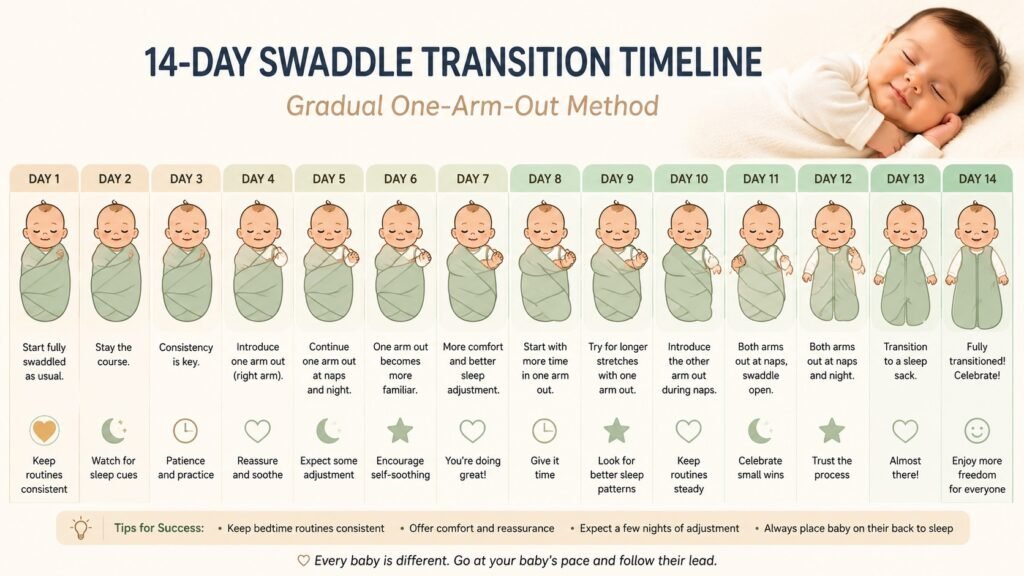
Method 1: The Gradual One-Arm-Out Approach (Most Recommended)
This is the gentlest, most widely used method and has the least impact on your baby’s sleep.
Here’s a real parent testimonial: “We used the Halo SleepSack and tried one arm out for two nights. She fussed a bit but adapted so quickly. By day five, both arms were out, and within a week, she was sleeping beautifully in her sleep sack!”
The Step-by-Step Timeline:
- Days 1–3: Start with just their daytime naps. Leave one arm out of the swaddle but keep. them fully swaddled at night. Begin with the first nap of the day, that way, if it fails, you haven’t wrecked the entire night.
- Days 4–6: Use the one-arm-out approach for both daytime naps and nighttime sleep.
- Days 7–9: Now it’s time for both arms out. Wrap the swaddle snugly around their chest and tummy, but let those little arms roam free.
- Days 10–14: Transition fully to a sleep sack or regular pajamas. Congratulations, you’ve made it!
Method 2: The Cold Turkey Approach (For Specific Situations)
This means stopping the swaddle completely, all at once, with no gradual steps.
When to use it:
- Your baby is already rolling (safety trumps everything, stop immediately).
- Your baby actively fights and rejects the swaddle every single time.
- Your baby can easily break out no matter how you wrap them.
The first 2 to 3 nights will likely be rough. There will be more wake-ups and more crying. But many babies adapt surprisingly quickly because the “band-aid” has been ripped off.
Method 3: The Transition Product Approach (Smooth Sailing)
Use specially designed transitional swaddles that give your baby the feeling of being held while gradually allowing arm freedom.
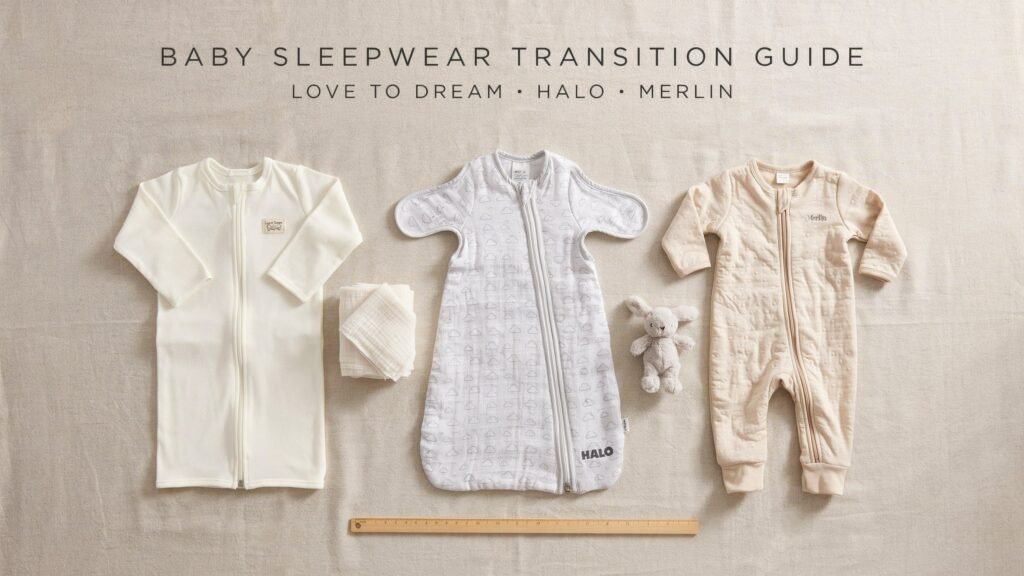
Transition Products: What to Use After Swaddling?
The market is flooded with products, and it’s easy to feel overwhelmed. Here’s a straightforward breakdown of the most popular options:
| Product Type | Top Brands | What It Does | Best For |
|---|---|---|---|
| Arms-Up Swaddle | Love to Dream Swaddle UP 50:50 | Allows baby to sleep with hands up; zip-off wings for gradual transition | Early transition stage |
| Detachable Sleeves | HALO SleepSack | Sleeves zip off one at a time | Gradual, step-by-step weaning |
| Magic Sleepsuit | Merlin Magic Sleepsuit | Thick, quilted suit that dampens the startle reflex | Babies having a really hard time transitioning |
| Regular Sleep Sack | Woolino, Kyte, ergoPouch | No arm restriction; wearable blanket | After the transition is complete |
What to Look for When Buying?
- Allows for gradual arm release.
- Breathable fabrics (cotton or bamboo).
- Correct TOG rating for your room temperature.
- No weighted inserts (the AAP strongly advises against these).
- Leaves room for healthy hip movement.
The 4-Month Sleep Regression + Swaddling: A Double Whammy?
If you’ve heard of the dreaded 4-month sleep regression, you might be worried. And you’re right to be cautious, it often overlaps perfectly with the swaddle transition window. This means your baby is dealing with a major biological shift in their sleep cycles at the exact same time they’re losing their beloved swaddle.
Should You Stop Before or After the Regression?
The best strategy: Start the transition before the regression hits, ideally around 3 to 3.5 months.
But what if you’re already in the thick of the regression? Stop swaddling anyway. Safety is non-negotiable, and you can handle both transitions at once, it’s harder in the short term, but you only have to survive the storm once.
4 Tips for Surviving Both Transitions
- Keep a consistent bedtime routine. Bath, massage, feed, story, the predictability is incredibly soothing for your baby right now.
- Max out tummy time during the day. The more they practice using their arms freely, the faster they’ll adapt to sleeping without restriction.
- Offer a pacifier. The AAP recommends pacifiers at sleep time to lower SIDS risk and they’re a great comfort tool during transitions.
- Keep the room cool and comfortable. Overheating is a risk, especially if they’re fussing more and working themselves up.
Most babies adjust to the new normal within 1 to 2 weeks. The storm doesn’t last forever.
FAQs: Common Questions About When to Stop Swaddling Baby
When should I stop swaddling baby?
You should stop swaddling your baby as soon as they show signs of attempting to roll over, this can happen as early as 2 months. Red Nose recommends stopping by 3 months at the latest, whichever comes first.
Can I swaddle my 3-month-old?
If your baby has no rolling signs whatsoever, you technically can. However, Red Nose recommends stopping at 3 months regardless, and most pediatricians agree babies should be swaddle-free before they hit 4 months.
Is it safe to swaddle a baby who rolls?
Absolutely not. It is a serious suffocation and SIDS risk. A rolling baby needs their arms free to lift their head and reposition.
How do I transition my baby out of the swaddle?
The gradual method is best: one arm out for a few days, then both arms out, then into a sleep sack. You can also use transitional products like Love to Dream or HALO SleepSack.
What if my baby won’t sleep without a swaddle?
This is completely normal. Be patient. Increase your soothing (patting, rocking, white noise), use a transition product, and stick with it for at least 1–2 weeks. They will learn.
How long does the swaddle transition take?
Usually 1 to 3 weeks, depending on your baby’s temperament. The gradual method typically takes about 10 to 14 days.
What is the best transition swaddle?
Popular options include Love to Dream Swaddle UP 50:50 (arms up), HALO SleepSack (detachable sleeves), and Merlin Magic Sleepsuit (for difficult transitions). Look for breathable fabric, the right TOG, and no weighted elements.
Do I need to stop swaddling at 2 months?
The AAP says: if your baby is trying to roll at 2 months, stop immediately. If they aren’t, you can continue but reassess at 3 months.
What’s the difference between a swaddle and a sleep sack?
A swaddle wraps tightly around the baby to suppress the startle reflex. A sleep sack is a zip-on wearable blanket that allows full arm movement. You transition from a swaddle to a sleep sack.
Does swaddling increase SIDS risk?
Swaddling itself is safe if the baby is on their back and not rolling. But if they roll over while swaddled, the SIDS risk increases dramatically.
What should I use instead of a swaddle?
Transition to a sleep sack. It provides warmth and security without restricting their arms.
When should I stop swaddling a premature baby?
Use your baby’s adjusted age, not their actual age. Always consult your pediatrician for personalized guidance for preemies.
Should I stop swaddling during the 4-month sleep regression?
Yes. Safety is more important than sleep quality. Start the transition before the regression hits (around 3 to 3.5 months) if possible. If you’re already in it, start now anyway.
How do I know if my baby is trying to roll?
Watch for them shifting to their side, lifting their shoulder, kicking their legs to gain momentum, or pushing up strongly during tummy time.
What if my baby still has a strong startle reflex at 4 months?
The reflex usually fades by 4 months. If it hasn’t, but they are showing rolling signs, safety wins. Stop the swaddle and use a transition product to soften the landing.

Summary and Action Plan: When to Stop Swaddling Baby
Let’s be honest for a moment. Saying goodbye to the swaddle can feel like letting go of a secret weapon. It’s completely normal to feel a mix of anxiety and wondering if you’re doing the right thing or if you’re about to ruin your baby’s sleep.
But here’s the truth I want you to hold onto: you are doing exactly what your baby needs.
This transition isn’t just about checking a safety box, it’s about honoring the incredible, unstoppable development happening inside that tiny body. Your baby is learning to move, to explore, and to find comfort in new ways. And while the first few nights without the swaddle might be a little bumpy, the strength and confidence you’re building in your little one? That lasts a lifetime.
So take a deep breath. Trust your instincts. You know your baby better than anyone else in the world. If a method doesn’t feel right, try another. If your baby needs an extra cuddle tonight, give it freely. There is no perfect timeline, no one-size-fits-all answer, just a loving parent doing their absolute best.
This phase, like all the others, is temporary. The sleepless nights will fade. The tears will stop. And one morning, not too long from now, you’ll look back and realize you navigated this transition with grace, patience, and so much love.
You are exactly the parent your baby needs. And you’ve got this one night, one little arm at a time.
Sweet dreams to you and your beautiful, growing baby.
Your Action Plan’s Checklist
- Observe your baby closely for any rolling attempts.
- If baby is ≥3 months or trying to roll, start your transition plan today.
- Choose your transition method (gradual, cold turkey, or product-assisted).
- Order or buy a transition product (sleep sack or transitional swaddle).
- Talk to your partner/caregiver so everyone follows the same plan.
- Reach out to your pediatrician if you have any specific health concerns.
If you’re in the thick of it right now, remember: this article will be here when you need a refresher. Bookmark it, share it with a fellow exhausted parent, and know that you are so not alone. We’re rooting for you.
Disclaimer
This article is for informational purposes only and does not constitute professional medical advice, diagnosis, or treatment. Always consult a qualified pediatrician or healthcare provider regarding your baby’s specific situation.