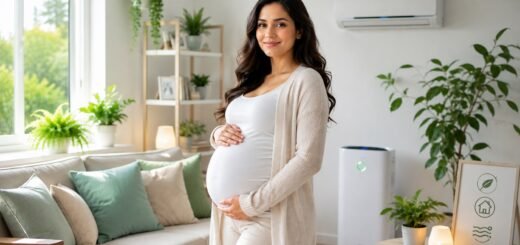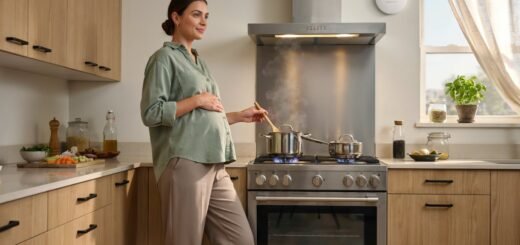
Best Air Purifier for Pregnancy: Safe HEPA Options for Cleaner Indoor Air
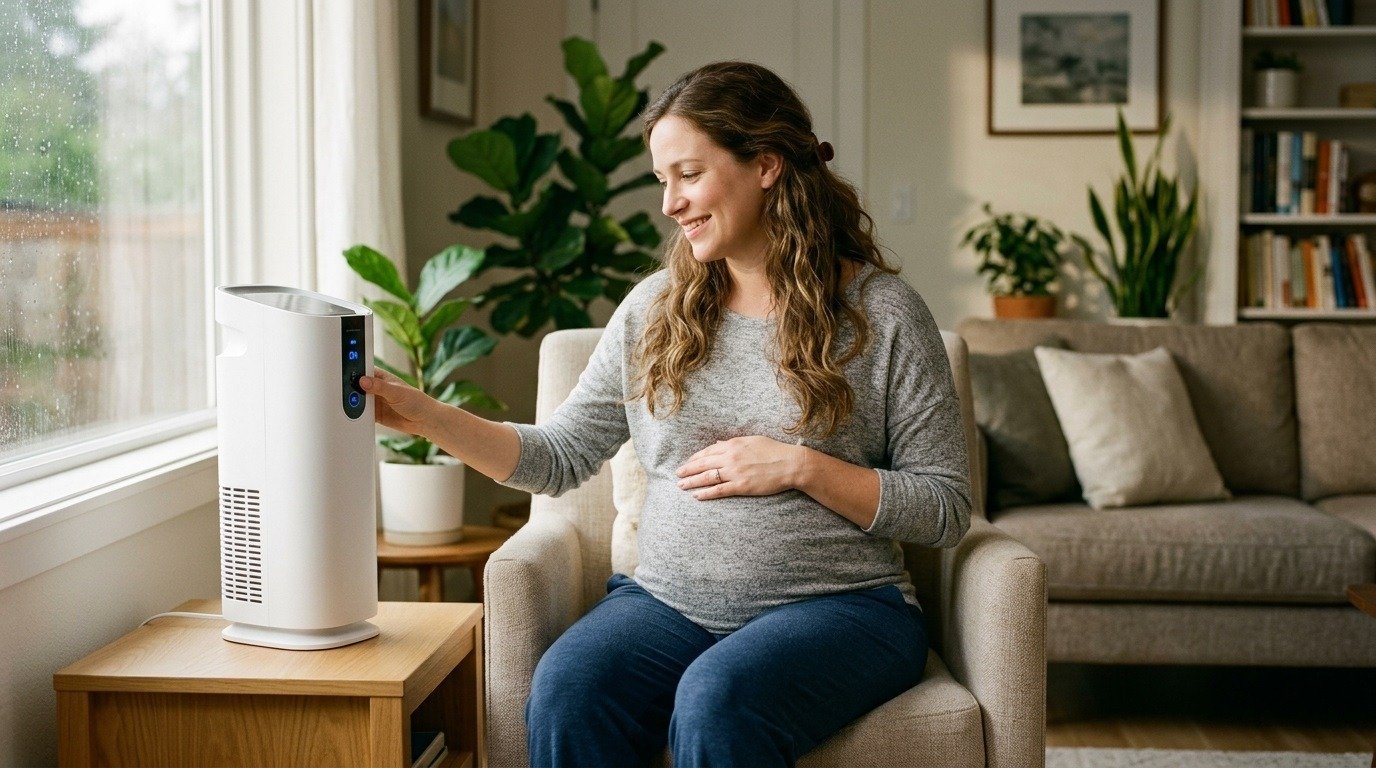
When you’re pregnant, it’s natural to think carefully about what you eat, drink, put on your skin, and bring into your home. But there is another part of your daily environment that is easy to overlook:
The air you breathe.
Indoor air quality during pregnancy is one of the most important factors for health as it can contain dust, pollen, pet dander, fine particles from smoke, and gases released by products and furnishings. So, if you’ve found yourself wondering, “Which is the best air purifier for pregnancy?”, you’re not alone.
The challenge is that shopping for one can quickly become overwhelming. One purifier promises to cover 2,000 square feet. Another says it has “medical-grade” filtration. Another has an ionizer, UV light, smart sensors, or a dozen different modes.
So, which features actually matter?
The short answer is that there is no official category of “pregnancy-approved air purifiers.” A better approach is to choose a purifier based on the pollutants you want to reduce, the size of your room, its particle-cleaning performance, and whether the device may intentionally produce ozone.
This guide will help you do exactly that.
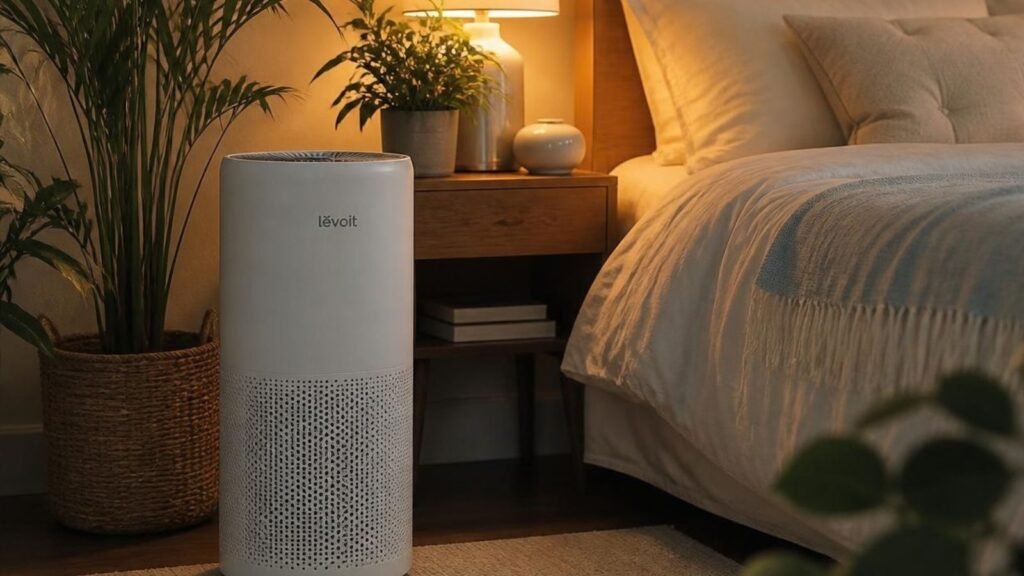
Best Air Purifier for Pregnancy: Quick Comparison
The choice for best air purifier during pregnancy depends on your room, budget, and primary concern. Compare products using factors such as CADR, room size, filtration technology, noise, filter costs, and independently verified performance where available.
| Best For | What to Look For | Why It Matters |
|---|---|---|
| Best overall | Strong particle CADR, effective mechanical filtration, reasonable filter costs | Provides a balanced solution for everyday bedroom or living-space use |
| Best budget | Adequate CADR for a smaller room and affordable replacement filters | A lower purchase price is only useful if ongoing maintenance remains affordable |
| Best for a bedroom | Quiet operation and sufficient CADR at a comfortable fan speed | You are more likely to run it consistently |
| Best for wildfire smoke | High tobacco-smoke CADR and effective particle filtration | Fine smoke particles require strong particle-cleaning performance |
| Best for a large room | Higher CADR and realistic room-size performance | Large spaces need more filtered airflow |
| Best for allergies or pets | Effective particle filtration and adequate airflow | Pollen, pet dander, and many allergens are particle concerns |
| Best for odors or some VOC concerns | Particle filtration plus substantial activated carbon | HEPA-type filtration primarily targets particles, not gases |
Our Recommendation Before Choosing a Model
Do not buy an air purifier simply because it says:
- “Pregnancy safe”
- “Removes toxins”
- “Cleans 99.9% of your home’s air”
- “Covers 2,000 square feet”
Instead, look for the actual performance information behind the marketing.
Specific models change, new versions are released, and product specifications can be updated. Before publishing a final product roundup, verify each model’s current CADR, filtration system, certifications, filter availability, and manufacturer specifications.
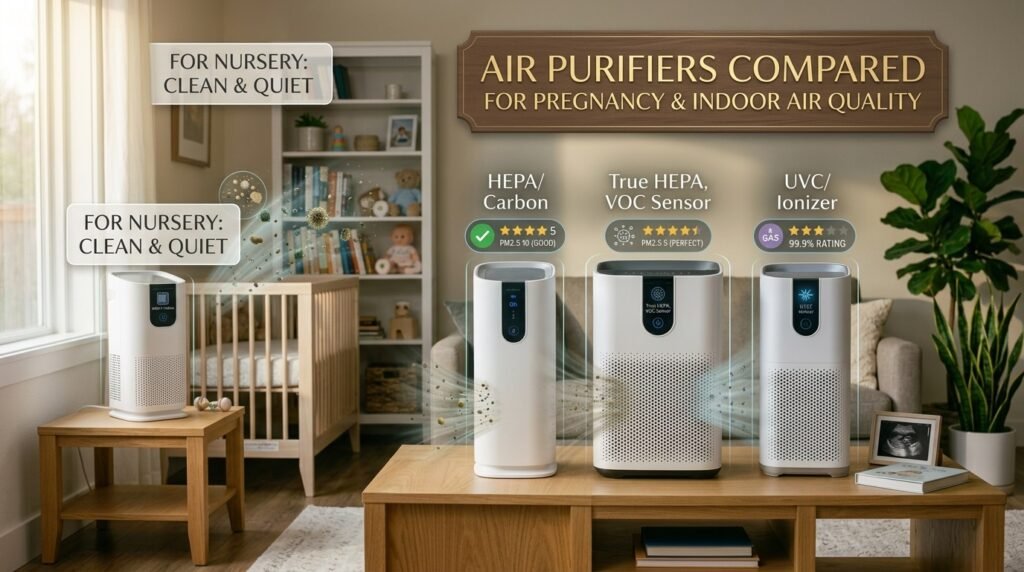
How to Select the Best Air Purifier for Pregnancy?
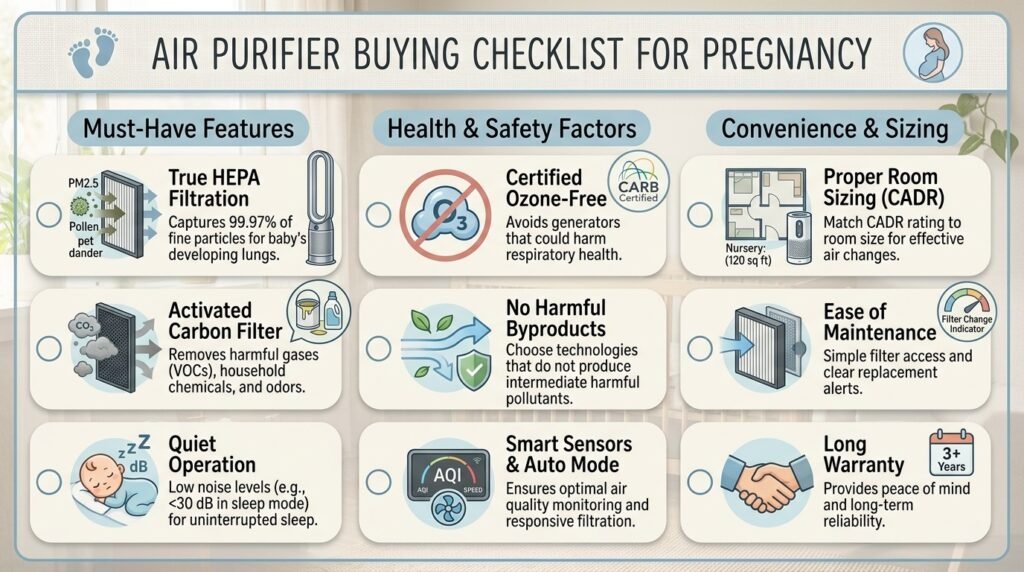
A useful air purifier for pregnancy should be based on more than customer ratings, or a manufacturer’s advertised square footage. We recommend evaluating air purifier using the following criteria:
- CADR and particle-cleaning performance
- Room size and realistic airflow needs
- Filtration technology
- Independently verified performance information, where available
- Ozone-emission considerations
- Activated carbon for gases and odors
- Noise level
- Replacement-filter cost and availability
- Energy use
- Long-term ownership costs
- Useful features, such as auto mode and filter reminders
We also considered common situations that may matter to expecting parents, including:
- Wildfire smoke
- Seasonal allergies
- Pets
- Bedroom air quality
- Nursery preparation
- Cooking-related particles
- Odors and certain VOC concerns
This approach follows an important principle from the U.S. Environmental Protection Agency; “portable air cleaners can supplement source control and ventilation, but they cannot remove every indoor pollutant or solve every indoor-air problem.”
Quick Answer: Which Is the Best Air Purifier for Pregnancy?
For most homes, a best air purifier for pregnancy should:
- Have effective mechanical particle filtration, such as HEPA filtration
- Have a CADR large enough for the room
- Avoid intentionally producing ozone
- Include activated carbon if gases or odors are an important concern
- Be quiet enough for regular use
- Have replacement filters you can realistically afford
- Provide transparent performance information
If wildfire smoke or fine-particle pollution is your main concern, prioritize particle filtration and tobacco-smoke CADR.
If odors or certain gases are your main concern, look for a purifier with activated carbon, while remembering that removing or reducing the pollution source is usually the first priority.
Are Air Purifiers Safe During Pregnancy?
A properly selected portable air cleaner can be part of a sensible strategy for improving indoor air quality during pregnancy. However, not all air purifiers use the same technology.
Some primarily use mechanical filtration. Others use ionization, electrostatic technology, plasma, UV, or combinations of technologies. That is why it is important to look beyond the word “air purifier.”
Can Pregnant Women Use Air Purifiers?
Yes. A portable air purifier during pregnancy can help reduce certain airborne pollutants when it is properly selected, sized, and maintained. But an air purifier is not a magic shield.
It cannot:
- Repair a mold problem
- Remove carbon monoxide from the air
- Solve a gas leak
- Eliminate radon
- Make heavy chemical exposure harmless
- Replace source control or appropriate ventilation
EPA guidance emphasizes that reducing or removing pollution sources and ventilating with clean outdoor air are important strategies, with filtration serving as an additional layer of protection.
What to Look for in an Air Purifier During Pregnancy?
Choose Effective Particle Filtration
If your concern involves:
- Dust
- Pollen
- Pet dander
- Fine particulate matter
- Wildfire smoke particles
HEPA is a familiar term for many shoppers. According to EPA, a HEPA filter is a pleated mechanical filter designed to remove at least 99.97% of specified 0.3-micron particles under the official definition and testing conditions.
But the filter itself is only part of the equation.
A purifier also needs to move enough air through that filter. That is where CADR becomes important.
Check CADR
CADR stands for Clean Air Delivery Rate. A higher CADR means the air cleaner can remove more particles from the air over time.
EPA provides the following estimated minimum CADR values for rooms with standard 8-foot ceilings:
| Room Area | Estimated Minimum CADR |
|---|---|
| 100 sq. ft. | 65 CFM |
| 200 sq. ft. | 130 CFM |
| 300 sq. ft. | 195 CFM |
| 400 sq. ft. | 260 CFM |
| 500 sq. ft. | 325 CFM |
| 600 sq. ft. | 390 CFM |
These are estimates, and higher ceilings may require a more powerful purifier.
Are Smart Sensors and Auto Mode Worth It?
Smart features can be convenient, but they are not essential for effective air cleaning.
Common features include:
- Air-quality sensors
- Auto mode
- Automatic fan-speed adjustment
- Mobile apps
- AQI displays
- Filter-replacement reminders
Auto mode may be convenient because the purifier can respond when its sensor detects a change in particle levels.
Look for Independently Verified Performance
When possible, don’t rely only on a manufacturer’s marketing claims.
Look for independently verified performance information, such as AHAM VERIFIED data where available. AHAM’s CADR program is designed to help consumers compare portable air-cleaner performance for particles. EPA also points consumers to AHAM information when discussing CADR and air-cleaner selection.
HEPA Vs. Activated Carbon: Which One Do You Need?
One of the biggest mistakes shoppers make is assuming that a HEPA filter removes everything. It doesn’t. A simple way to think about it is:
Mechanical/HEPA filtration = primarily particles
Activated carbon = can help reduce some gases and odors
| Indoor Air Concern | Particle Filtration | Activated Carbon |
|---|---|---|
| Dust | Yes | Not the primary solution |
| Pollen | Yes | Not the primary solution |
| Pet dander | Yes | Not the primary solution |
| PM2.5 | Yes | No |
| Smoke particles | Yes | No |
| Some odors | Limited | May help |
| Some gases and VOCs | No | May help |
| Carbon monoxide | No | No |
| Radon | No | No |
EPA notes that activated carbon or another gas-adsorbing filter may help filter gases, but the amount of material matters, and there is no widely used CADR-style rating system for gas removal.
So, if VOCs are your biggest concern, don’t assume that a purifier with a thin carbon layer will solve the problem.
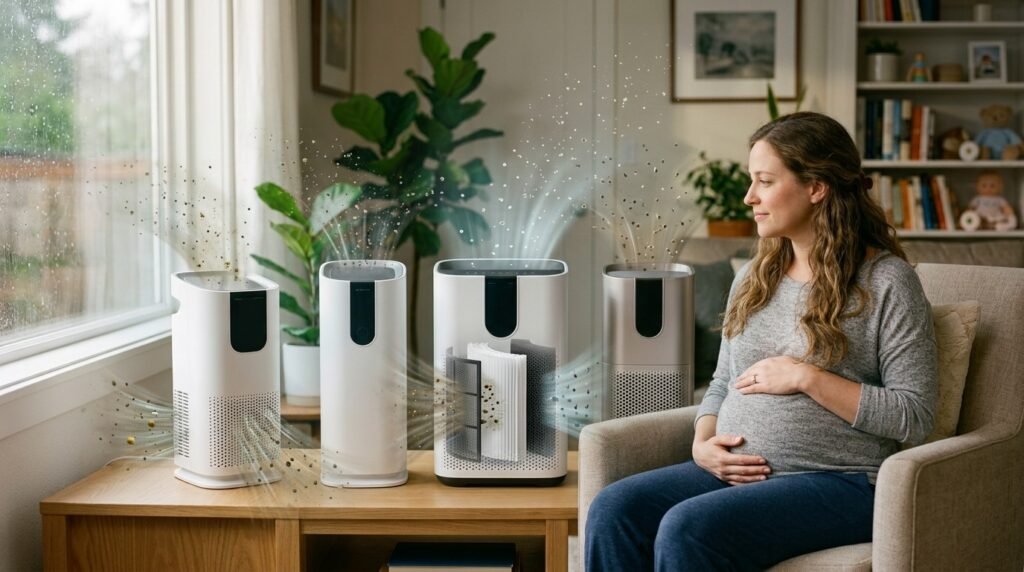
How Big of an Air Purifier Do You Need?
How to Calculate Your Room Size?
Start by measuring the room:
Length × width = square footage
For example; 12 feet × 15 feet = 180 square feet
If you have an open floor plan, consider the entire connected space the purifier is expected to serve. High ceilings also increase the amount of air in the room, so you may need a more powerful unit.
Why Air Changes Per Hour Matter?
A purifier may claim that it can “cover” a huge room. But that statement can be misleading. Why?
Because a purifier might technically filter a large room slowly, while filtering a smaller room much more frequently.
This is where air changes per hour (ACH) can be useful. ACH estimates how often the volume of air in a room can theoretically be cleaned or replaced with filtered air within an hour.
For example, a purifier may provide:
- Fewer air changes in a large room
- More frequent cleaning in a smaller room
Is Bigger Always Better?
Not necessarily. A very large purifier may be:
- More expensive
- Bulkier
- Noisier
- More costly to maintain
But buying a unit with more capacity than the absolute minimum can give you flexibility. You may not need to run it on its loudest setting all the time.
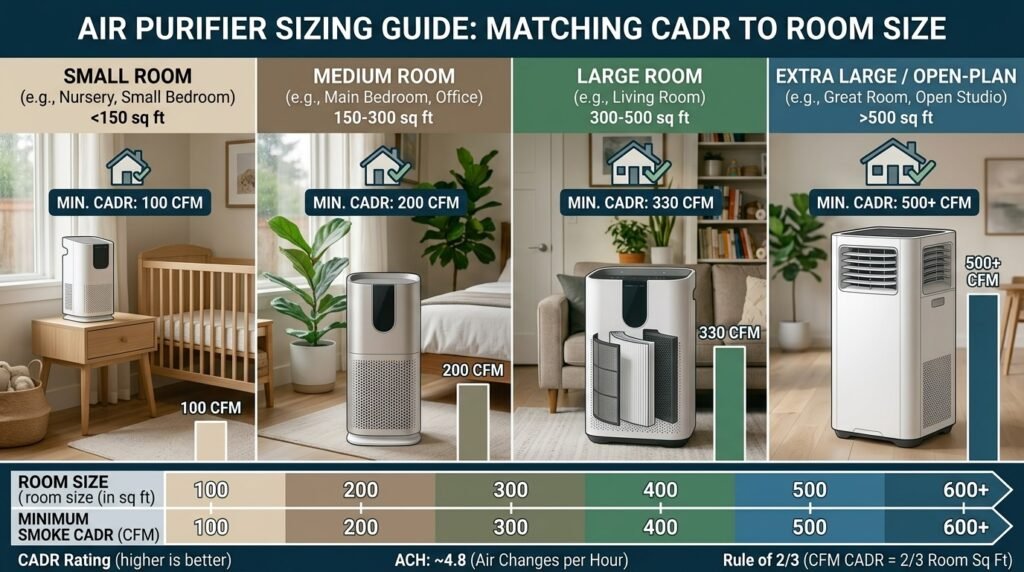
Air Purifier Features to Avoid or Question During Pregnancy
Ozone Generators
Ozone is a lung irritant. EPA advises avoiding portable air cleaners and filters that intentionally produce ozone. Some air-cleaning technologies may also have the potential to emit ozone.
For a bedroom, nursery, or other occupied living space, there is little reason to deliberately choose an ozone-generating device.
Consider CARB Certification or Other Ozone-Emission Information
The California Air Resources Board (CARB) maintains requirements related to ozone emissions from certain portable air-cleaning devices.
For example, EPA’s current wildfire cleaner-air-room guidance recommends using CARB-certified air cleaners because they produce little or no ozone. CARB certification or other credible ozone-emission information can therefore be useful when comparing products. However:
CARB certification does not mean a product is “approved for pregnancy.”
It is simply one piece of information about the device.
Ionizers and Bipolar Ionization
Ionization is different from mechanical filtration. EPA describes bipolar ionization as an emerging technology with less documented evidence for safety and effectiveness than established filtration methods in typical real-world conditions.
Some ionization technologies also have the potential to generate ozone or other by-products unless specific precautions are taken. EPA recommends looking for UL 2998 zero-ozone certification if choosing a device that uses bipolar ionization.
Fragrance and Aromatherapy Features
If you are buying an air purifier to improve indoor air quality, added fragrance is not necessary. If smells or sensitivities are bothering you during pregnancy, adding another scent to the room may not be helpful.
Simple, effective filtration is often the better priority.
Be Skeptical of Overblown Claims
Be cautious when you see statements such as:
- “Removes all toxins”
- “Eliminates every chemical”
- “Makes your air perfectly pure”
- “Protects your unborn baby”
- “Removes 100% of indoor pollution”
No portable air purifier can guarantee those outcomes.
Why PM2.5 Matters During Pregnancy
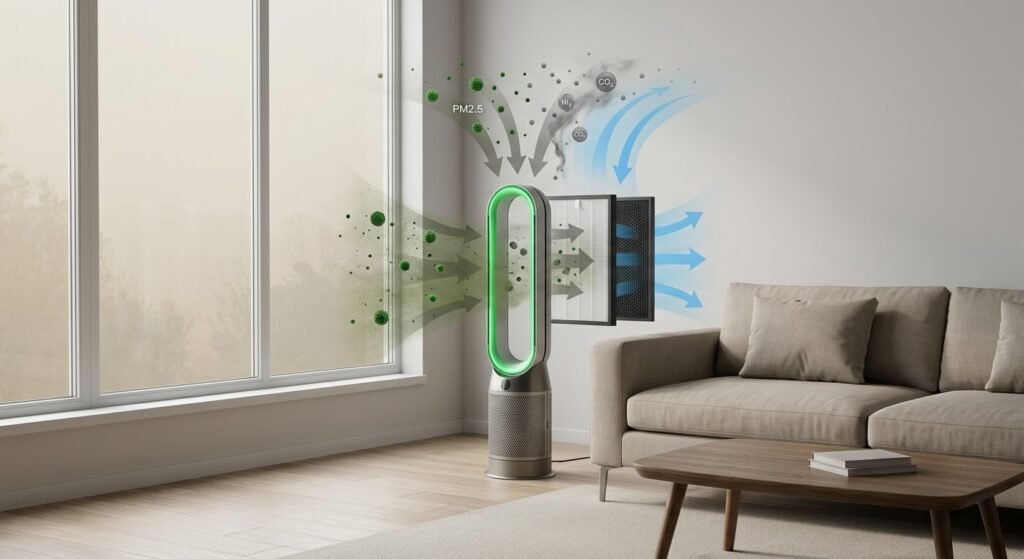
PM2.5 refers to very small airborne particles that are 2.5 micrometers or smaller.
Common sources include:
- Wildfire smoke
- Traffic-related pollution
- Wood smoke
- Cooking
- Other combustion sources
These particles can remain suspended in the air and may enter homes from outdoor pollution.
EPA identifies PM2.5 as one of the indoor particulate pollutants that portable air cleaners may help reduce.
Research has also examined associations between prenatal exposure to fine particulate matter and certain pregnancy and birth outcomes. However, environmental exposure is complex, and it is important not to overstate what an individual air purifier can accomplish. A practical goal is simply to:
Reduce avoidable particle exposure when possible.
That may be particularly relevant during:
- Wildfire-smoke events
- Periods of poor outdoor air quality
- Heavy indoor particle generation
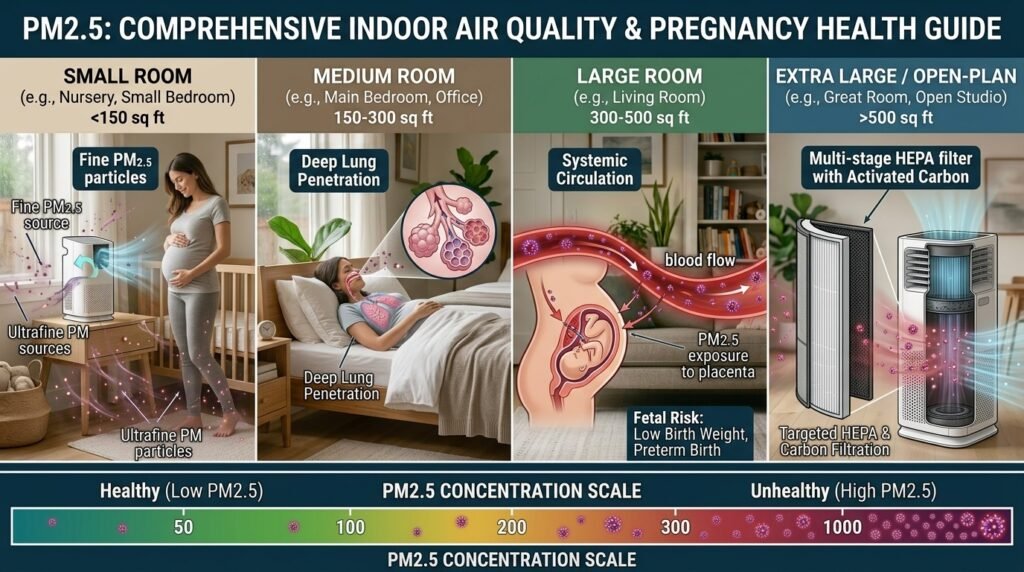
Best Air Purifier for Pregnancy During Wildfire Smoke
Wildfire smoke is one situation where choosing the right purifier during pregnancy can make a practical difference.
For smoke events, prioritize:
- Effective particle filtration
- A high tobacco-smoke CADR
- Correct room sizing
- Low or no ozone emissions
EPA’s current cleaner-air-room guidance recommends choosing a portable air cleaner with a tobacco-smoke CADR of at least two-thirds of the room’s area in square feet.
Create a Cleaner-Air Room
During significant smoke events, you may want to focus on one room where you can spend more time.
EPA recommends choosing a room large enough for household members to be comfortable and using a portable air cleaner in that space.
You may also want to:
- Keep doors and windows closed when outdoor smoke conditions warrant it
- Avoid burning candles or incense
- Reduce frying and other particle-producing activities
- Avoid indoor smoking
- Keep replacement filters available
- Use an appropriately compatible high-efficiency HVAC filter if your system can accommodate one
Best Air Purifier for Pregnancy and VOCs
What Are VOCs?
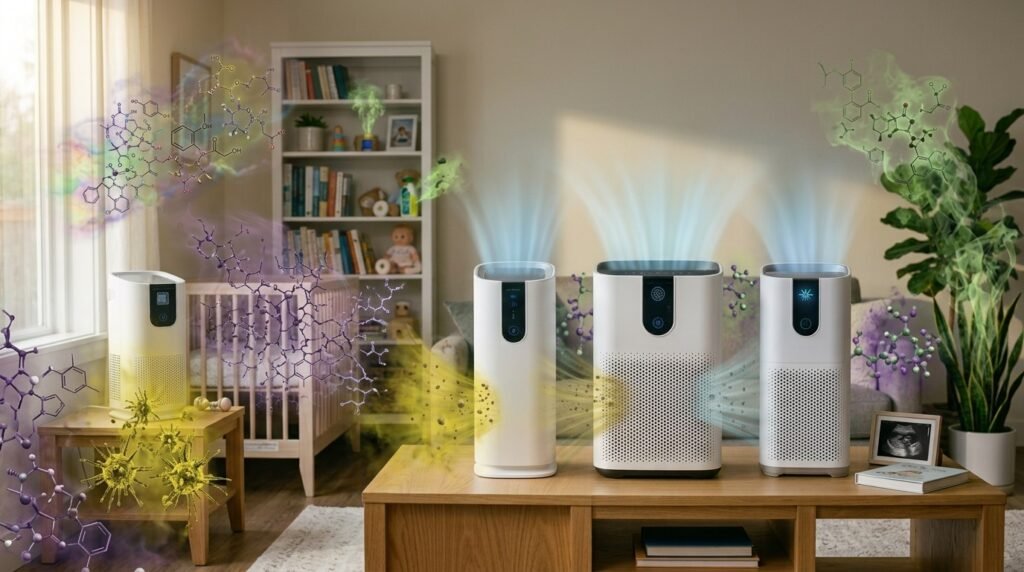
VOCs, or volatile organic compounds, are gases emitted from certain products and materials.
Potential household sources can include:
- Paint
- Adhesives
- Cleaning products
- Solvents
- Furniture
- Flooring
- Fragranced products
Does HEPA Remove VOCs?
HEPA filtration primarily targets particles rather than gases.
If gas removal is important, look for activated carbon or another filter specifically designed to adsorb gases.
EPA notes that the amount of activated carbon matters and that thicker or more substantial carbon media can provide greater gas-removal capacity.
Source Control Comes First
Suppose you’re preparing a nursery and a new piece of furniture has a strong odor. Don’t assume a small purifier will make the problem disappear.
Consider:
- Reducing or removing the source when practical.
- Following manufacturer instructions.
- Ventilating with clean outdoor air when appropriate.
- Avoiding unnecessary chemical exposure.
- Using an air cleaner as an additional layer.
That approach is more realistic than expecting one device to “remove all chemicals.”
Common Indoor Air Pollution Sources During Pregnancy
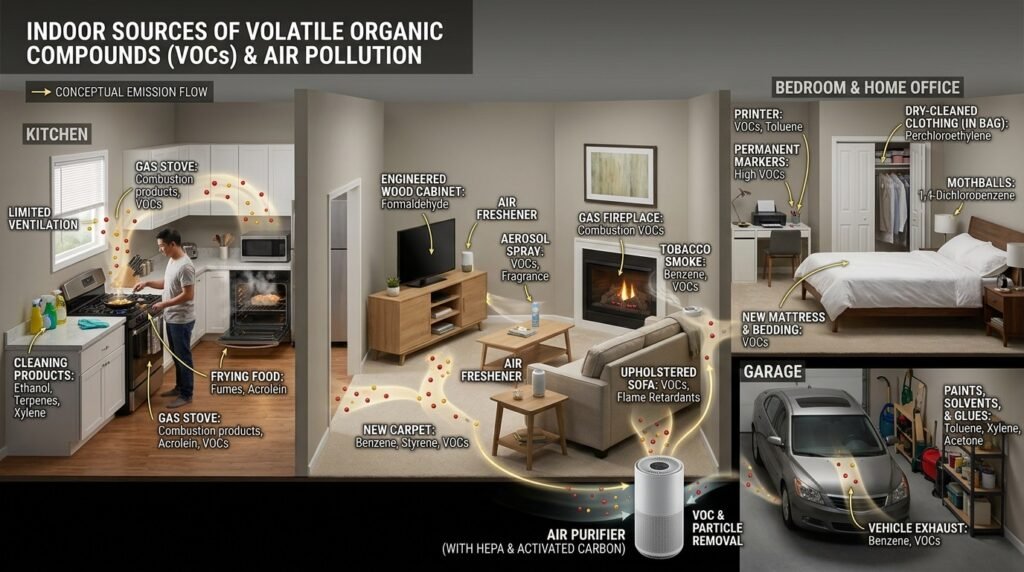
Before choosing an air purifier, it helps to identify where your air-quality concerns may be coming from.
Kitchen
Potential sources include:
- Frying
- Cooking smoke
- Burned food
- Gas combustion
- Poor ventilation
An air purifier may help reduce particles after they enter the room, but controlling pollution near the source is often more effective. Use appropriate kitchen ventilation for safety from gas and smoke whenever possible while pregnant.
Bedroom
Potential concerns include:
- Dust
- Pollen entering from outdoors
- Pet dander
- Outdoor particle pollution
Because you may spend seven, eight, or more hours sleeping in the same room, the bedroom is often a practical location for a portable air cleaner.
Nursery Preparation
Potential sources may include:
- Fresh paint
- New furniture
- Flooring
- Adhesives
- Strong fragrances
Reducing unnecessary emissions and ventilating appropriately can be more effective than relying only on filtration.
Living Areas
Potential sources include:
- Dust
- Pet dander
- Candles
- Fireplaces
- Cooking particles
- Outdoor pollution
Identifying the likely source helps you choose the right strategy.
Which Air Purifier Is Best for Your Situation?
There is no single “best” purifier for everyone.
If You Live in a Wildfire-Prone Area
Prioritize:
- High tobacco-smoke CADR
- Effective particle filtration
- Appropriate room sizing Continuous operation during significant smoke events
If You Have Seasonal Allergies
Prioritize:
- Effective particle filtration
- Adequate CADR
- Quiet operation
An air purifier may reduce airborne particles such as pollen, but it should complement other allergy-management strategies.
If You Have Pets
Look for:
- Effective particle filtration
- Adequate airflow
- Practical maintenance for managing pet allergies during pregnancy
Regular vacuuming and cleaning pet bedding still matter. An air purifier does not eliminate the need to clean your home.
If You’re Preparing a Nursery
Prioritize:
- Quiet operation
- Appropriate room size
- Safe placement
- Clear ozone-emission information
- Affordable replacement filters
The goal is not to create a sterile environment. It is to reduce relevant airborne pollutants in a practical and sustainable way to create a safe home environment for you and newborn.
If You’re Concerned About Odors or VOCs
Prioritize:
- Source control
- Appropriate ventilation
- Activated carbon
- Realistic expectations
Remember that a purifier cannot always compensate for an ongoing, strong pollution source.
Where Should You Put an Air Purifier During Pregnancy?
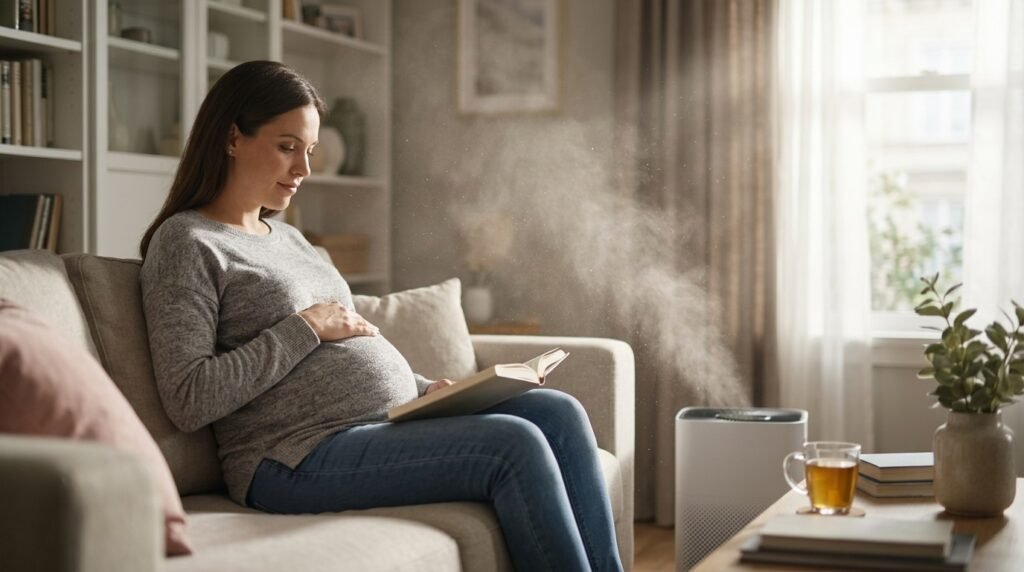
Placement matters a lot.
Best Placement in a Bedroom
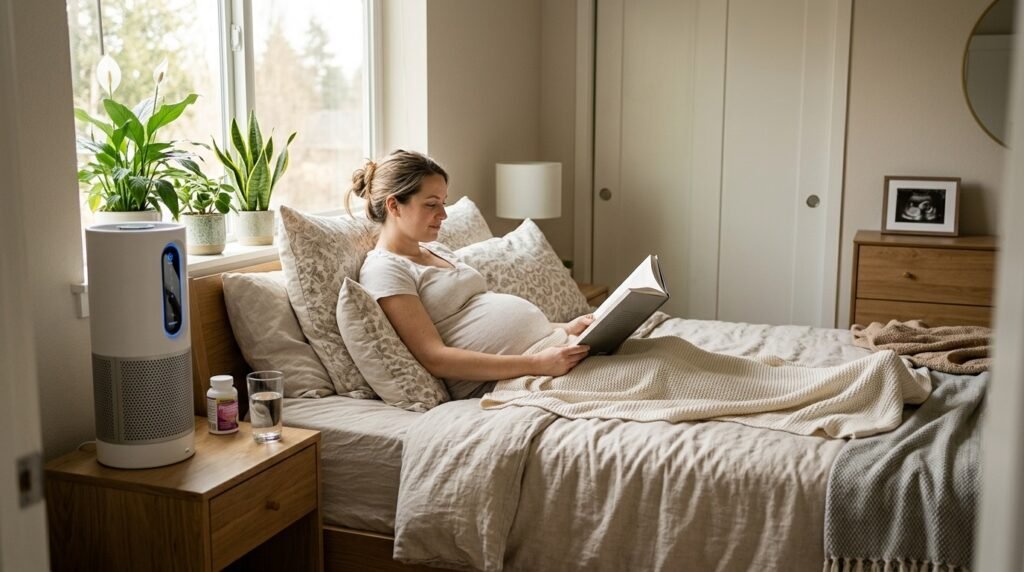
Place the air purifier:
- On a stable surface or floor
- With clearance around the intake and outlet
- Away from furniture that blocks airflow
- Where the cord does not create a tripping hazard
Avoid placing it tightly against a wall or behind curtains. The device needs enough space to move air.
Can You Put an Air Purifier Next to Your Bed?
Usually, yes, provided you follow the manufacturer’s placement instructions. If the airflow or noise bothers you, move it farther away while keeping it in the same room.
Where Should a Nursery Air Purifier be Placed?
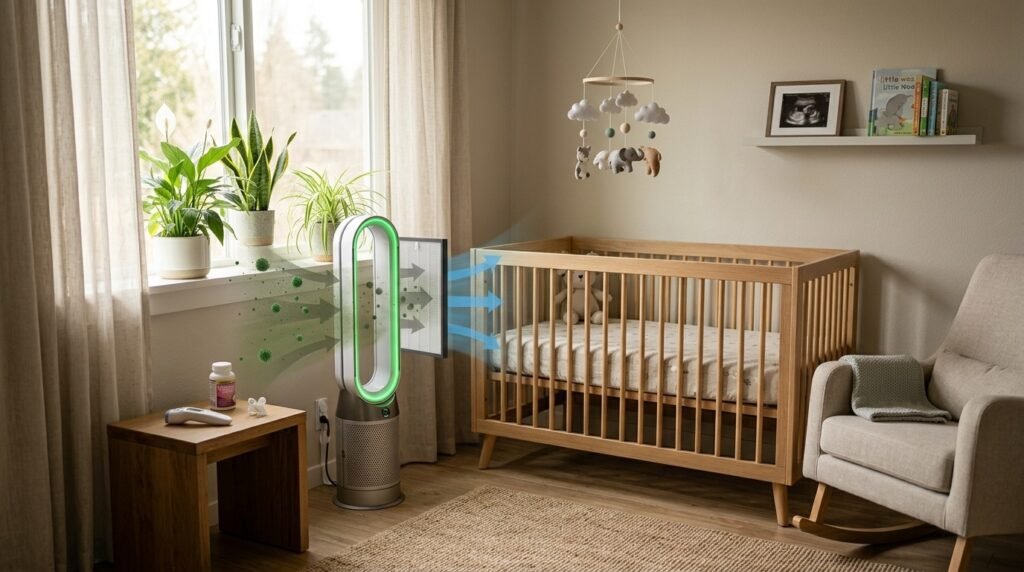
Choose a stable location where:
- The purifier cannot easily be knocked over
- The cord is inaccessible to a child
- The intake and outlet are unobstructed Airflow is not blowing directly into the baby’s face
Can You Sleep with an Air Purifier While Pregnant?
A properly selected portable air cleaner can run while you sleep. For overnight use:
- Follow manufacturer instructions
- Choose an appropriate room size
- Avoid intentionally ozone-producing devices
- Keep the air pathways clear
- Select a comfortable noise level
- Replace filters as needed
A quieter purifier that you actually run every night may be more useful than a powerful purifier that you regularly turn off because it is too loud.
How Long Should You Run an Air Purifier?
Generally, longer run times mean more air passes through the filtration system.
How long you run it depends on:
- Room size
- Pollution levels
- Outdoor air quality
- Fan speed
- The purifier’s performance
You may choose to run it:
- Overnight in your bedroom
- Continuously during wildfire smoke
- More frequently during allergy season
- After particle-producing activities such as cooking
EPA notes that higher fan speeds and longer run times generally increase the amount of air filtered.
Do You Really Need an Air Purifier During Pregnancy?
You may be more likely to benefit from considering a portable air cleaner if:
- Wildfire smoke affects your area
- Outdoor particle pollution is high
- Seasonal allergies are a major concern
- You have pets
- Indoor particles are a persistent problem
- You want to improve filtration in the bedroom
But don’t forget the basics.
Source Control Still Comes First
Whenever practical:
- Reduce or remove pollution sources
- Avoid indoor smoking
- Use kitchen ventilation
- Address water leaks
- Fix mold and moisture problems
- Choose lower-emission products when possible
- Ventilate with clean outdoor air when appropriate
Frequently Asked Questions: Best Air Purifier for Pregnancy
Are air purifiers safe during pregnancy?
A properly selected portable air cleaner can help reduce certain airborne pollutants. Choose a purifier appropriate for your room and avoid devices that intentionally produce ozone.
Can pregnant women use HEPA air purifiers?
Yes. HEPA is a mechanical particle-filtration technology commonly used in portable air cleaners. EPA recommends considering appropriately sized portable air cleaners with HEPA filtration or adequate CADR for particle removal.
Can I sleep with an air purifier while pregnant?
Yes, a properly selected portable air cleaner can be used overnight. Follow the manufacturer’s instructions and choose a comfortable noise level.
Are ozone air purifiers safe during pregnancy?
EPA advises avoiding air cleaners that intentionally produce ozone because ozone is a lung irritant.
Does HEPA remove PM2.5?
Effective HEPA or other high-efficiency particle filtration can reduce fine airborne particles, including PM2.5, when the purifier is properly designed and sized for the room.
Does HEPA remove VOCs?
Not effectively. HEPA primarily targets particles. Activated carbon or another gas-adsorbing filter is more relevant for certain gases and VOCs.
Can an air purifier remove wildfire smoke?
A properly sized portable air cleaner can help reduce wildfire-smoke particles indoors. Look for effective particle filtration and an adequate tobacco-smoke CADR.
Can an air purifier help with pregnancy congestion?
Pregnancy-related nasal congestion can have other causes, so an air purifier may not solve the problem completely.
Do I need more than one air purifier during pregnancy?
Not necessarily. A portable air purifier primarily cleans the air in the room where it is located. If you spend most of your time in one bedroom, starting with one properly sized unit may make more sense than buying several small purifiers.
Should I run an air purifier after cooking?
An air purifier may help reduce some airborne particles produced during cooking. However, use appropriate kitchen ventilation and try to reduce excessive smoke before it spreads through the home.
Is a UV air purifier necessary during pregnancy?
Usually, UV technology is not necessary for reducing common particles such as dust, pollen, pet dander, or PM2.5.
If your primary concern is particles, focus first on effective mechanical filtration and adequate airflow.
What CADR should I look for?
Choose a CADR appropriate for your room size.
As an EPA-based estimate, a 300-square-foot room with a standard 8-foot ceiling corresponds to a minimum CADR of approximately 195 CFM.
Can an air purifier remove carbon monoxide?
Do not rely on a standard portable air purifier to remove carbon monoxide. Use properly installed carbon monoxide alarms and address the source of carbon monoxide.
Can an air purifier solve a mold problem?
No. An air purifier may capture some airborne particles, but it does not fix the moisture problem that allows mold to grow.
Final Thoughts: How to Choose the Best Air Purifier for Pregnancy
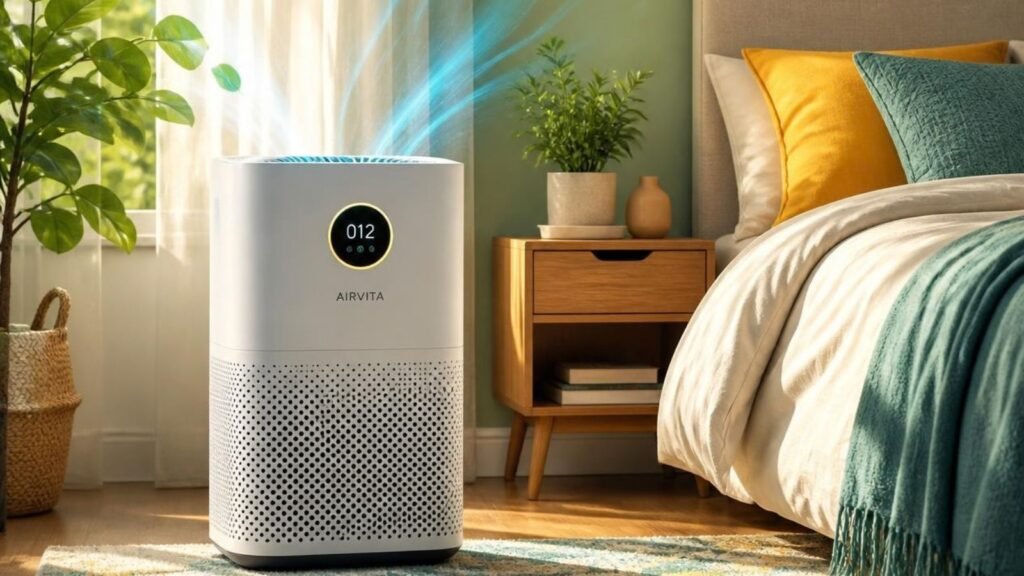
Choosing the best air purifier for pregnancy does not have to mean buying the most expensive machine or the one with the long list of features.
If your main concern is:
- Dust, pollen, pets, or PM2.5: prioritize effective particle filtration and CADR.
- Wildfire smoke: prioritize strong particle filtration and tobacco-smoke CADR.
- Odors or certain VOCs: look for substantial activated carbon while focusing on source control.
- A bedroom or nursery: choose an appropriately sized, quiet unit with clear performance information.
And don’t let marketing language make the decision for you. The best air purifier for pregnancy is one that:
- Fits your room
- Addresses your actual air-quality concern
- Does not intentionally generate ozone
- Is maintained properly
- Is affordable to operate over time
- Is powerful enough to provide meaningful filtration
You simply want to make thoughtful choices about the environment where you rest, sleep, and prepare for your baby’s arrival.
And the best air purifier for pregnancy is not necessarily the most expensive one. It is the one that is appropriately sized for your room and designed to reduce the pollutants you are actually concerned about.
Did this article help you? Consider sharing it with another mom to be. Drop in your comment for feedback and suggestions and stay connected for more useful articles.