Safe Baby Teething Remedies: AAP-Approved Guide (2026) to Soothe Your Baby
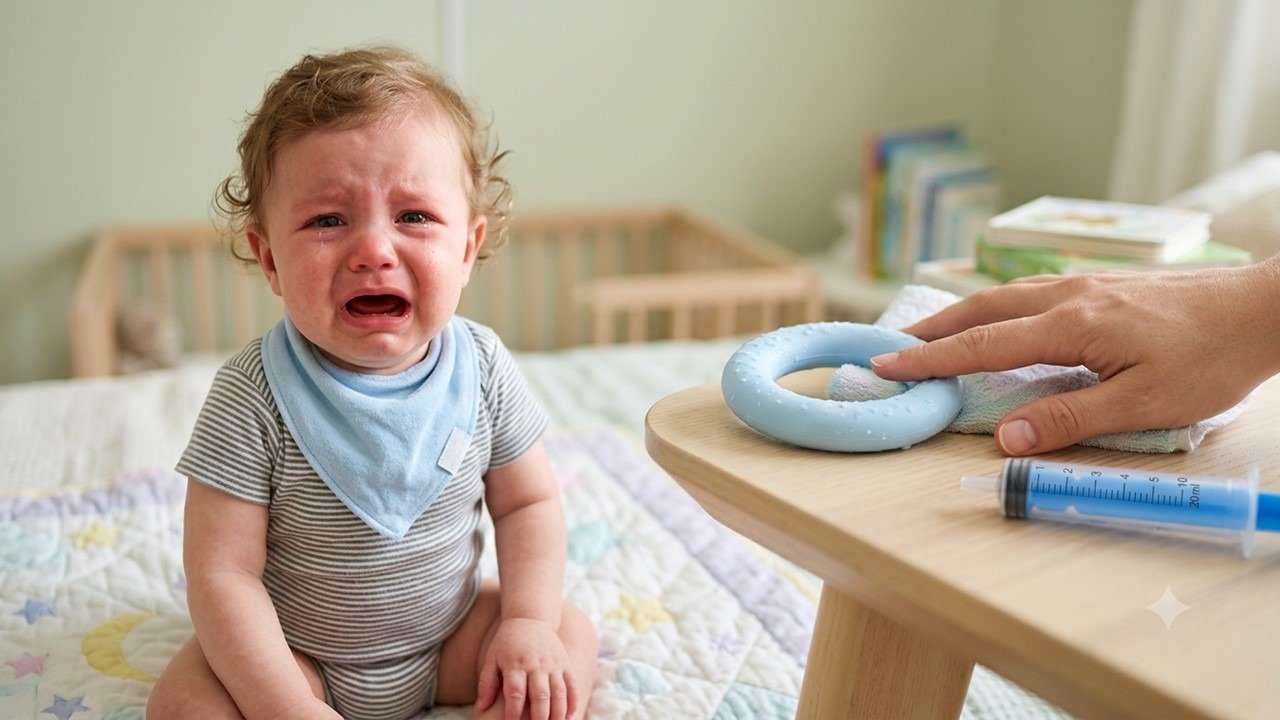
It’s 2:00 AM, and the baby monitor crackles to life with a cry that doesn’t sound like hunger or a wet diaper. You stumble into the nursery, scoop up your little one, and notice the telltale drool-soaked onesie and tiny fists gnawing away at anything they can reach. Your heart aches because you know what this is, “teething”. And in that foggy, exhausted moment, all you want is something, anything, that will safely ease their pain so you can both get some rest.
If this scene feels familiar, you are not alone. Navigating the world of baby teething remedies can be overwhelming. Between well-meaning advice from relatives, conflicting information online, and a pharmacy aisle full of products, it’s hard to know what’s truly safe and what actually works.
That’s why we’re turning to the experts. The American Academy of Pediatrics (AAP) provides clear, evidence-based guidance for soothing sore gums. They recommend starting with gentle, non-medication approaches like massaging the gums with a clean finger or offering a chilled (not frozen) teething ring made of firm rubber. For more persistent pain, the AAP suggests acetaminophen as the preferred medication for infants under six months.
However, the AAP and the FDA also issue critical safety warnings about what not to use for baby teething remedies. The FDA has specifically advised parents to avoid teething gels and products containing benzocaine for children under two years old, as they can cause a rare but life-threatening blood disorder.
In this guide, we’ll cut through the noise and give you a clear, step-by-step plan for managing your baby’s teething pain. We’ll cover the safest and most effective baby teething remedies from simple at-home comforts to over-the-counter medications and help you know exactly when it’s time to call the pediatrician. Your baby’s comfort and safety are the top priority, and we’re here to help you navigate this challenging (but temporary!) milestone with confidence.

What Is Teething? Understanding the Timeline
When Do Babies Start Teething?
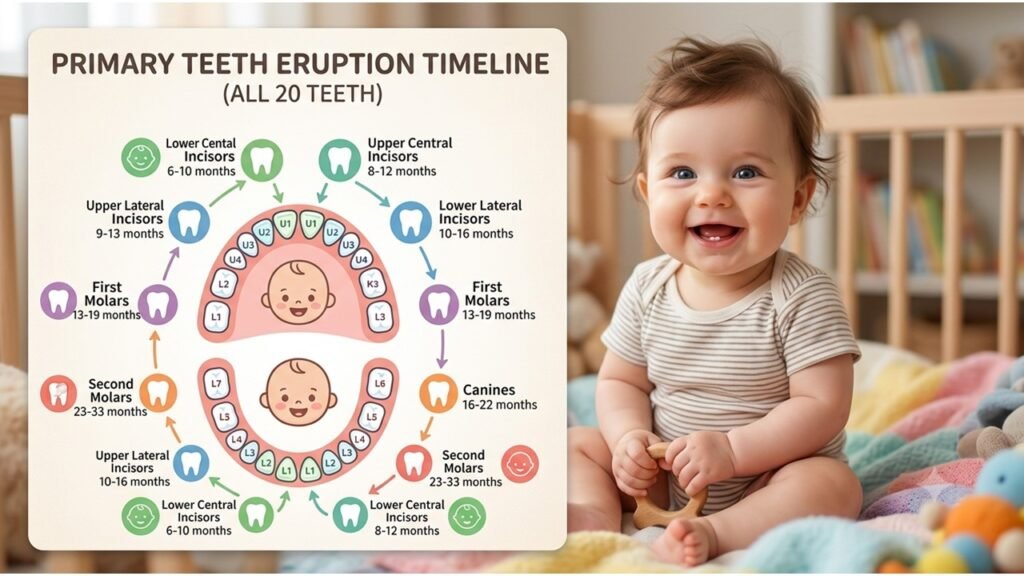
Most babies get their first tooth between 6 and 10 months of age. But here’s the thing, teething discomfort can start weeks or even months before that first pearly white actually breaks through. Some babies begin showing signs as early as 3 months.
The first teeth to appear are almost always the lower central incisors, the two front teeth on the bottom. By age 3, most children will have all 20 of their primary (baby) teeth.
Do remember that every baby is different. Some are born with a tooth (rare!), while others don’t get their first until after their first birthday. If your 12-month-old still has a gummy smile, don’t panic, it’s usually within the normal range.
How Long Does Teething Pain Last?
Each tooth typically causes discomfort for a few days before it breaks through the gum. The most intense pain usually lasts 3 to 5 days per tooth. Since babies have 20 teeth coming in over about 2.5 years, teething can feel like a never-ending cycle. But remember, the toughest days are usually short-lived.
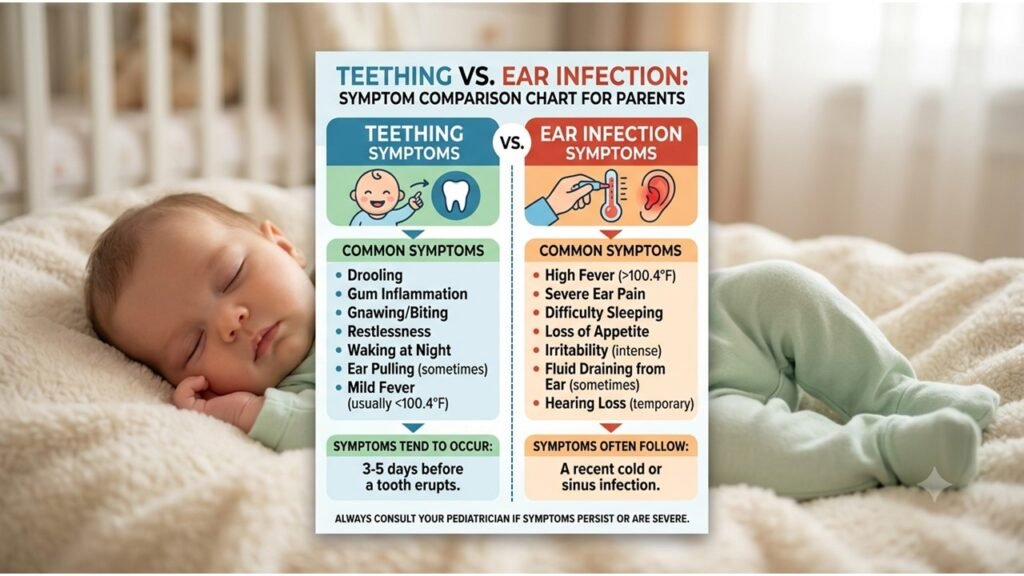
True Signs of Teething vs. Symptoms That Signal Something Else
This is where a lot of parents get confused and it’s completely understandable. When your baby is fussy, drooling, and running a slight temperature, it’s natural to blame teething.
But here’s what the AAP wants you to know:
What Teething Actually Causes:
According to HealthyChildren.org, teething babies may:
- Drool, way more than usual (hence the soaked onesies).
- Chew on everything in sight like toys, fingers, your shoulder.
- Develop a rash around the mouth, this is typically from drool irritating their delicate skin.
- Act fussy or irritable, this is because swollen gums are uncomfortable.
- Have slightly elevated temperature but not a true fever.
What Teething Does NOT Cause:
Extensive studies show that teething does NOT cause:
- Fever above 100.4°F (38°C): if your baby hits this threshold, it’s not teething
- Diarrhea: teething doesn’t change how your baby’s gut works
- Diaper rash: except possibly around the mouth, teething doesn’t affect skin sensitivity
- Severe crying: teething discomfort is generally not severe enough to cause nonstop crying
- Difficulty fighting off colds: teething doesn’t affect the immune system.
Expert’s Insight:
The Cleveland Clinic puts it bluntly: “If your baby has a fever of 100.4 F or higher, don’t ignore it and chalk it up to teething. A fever is a sign of an infection, not teething”.
When to Suspect an Illness Instead of Teething
If your baby has any of these symptoms, call your pediatrician, don’t blame teething:
- Fever over 100.4°F.
- Diarrhea lasting more than 24 hours.
- Refusing all fluids.
- Symptoms that persist beyond 2 to 3 days.
- Signs of ear infection (tugging at ears, fever, trouble sleeping).
Teething Rash: How to Prevent and Treat Drool Rash
That red, irritated rash around your baby’s mouth, chin, neck, and even chest? It’s likely drool rash and it’s one of the most common side effects of teething.
Why it happens?
Teething triggers excessive drooling. The constant moisture on your baby’s delicate skin breaks down the skin barrier, leading to redness, irritation, and sometimes small bumps.
How to Prevent?
- Wipe frequently: gently pat (don’t rub) drool away with a soft cloth throughout the day.
- Apply a barrier: a thin layer of coconut oil or a petroleum-based ointment (like Aquaphor or Vaseline) creates a protective shield between drool and skin.
- Change bibs often: keep a stack of clean, dry bibs handy and swap them out as soon as they get wet.
- Use a gentle cleanser: wash your baby’s face with warm water and a mild, fragrance-free soap, then pat dry.
When to see a doctor?
Most drool rashes clear up with simple care. Call your pediatrician if the rash:
- Develops open sores or crusting.
- Spreads despite treatment.
- Seems painful or causes your baby distress.
- Is accompanied by fever.
How to Choose Baby Teething Remedies: A Parent’s Decision Tree
Not all teething pain is created equal. Here’s a simple way to think about it:
Mild Discomfort: Start with Non-Medication Comfort Measures
If your baby is a little fussy but still eating, sleeping, and playing relatively normally, start with the gentle stuff we’ll cover below.
Moderate Discomfort: Add OTC Pain Relievers
If your baby is visibly uncomfortable, refusing food, or having trouble settling, it’s time to consider acetaminophen or ibuprofen (age-dependent).
Severe Discomfort: Consider Medication on a Schedule
If pain is persistent and your baby is genuinely suffering, the AAP recommends giving acetaminophen on a regular schedule rather than just as needed.
Nighttime Flare-Ups: Special Overnight Strategies
We’ll dedicate a whole section to this below because we know night-time is when teething feels the hardest.
5 Safe Baby Teething Remedies That Actually Work
1. Gentle Gum Massage
This is the simplest, cheapest, and often most effective remedy. And you can do it anywhere, anytime.
How to do it:
- Wash your hands thoroughly.
- Use a clean finger or a piece of wet gauze.
- Gently rub your baby’s gums for about 2 minutes.
- Focus on the sore, swollen areas.
- You can do this as often as needed.
Why it works?
The pressure on the gums can decrease pain signals and provide real relief. Think of it like rubbing a sore muscle, it just helps.
Some babies love this. Others will clamp down with those gums (and eventual teeth!) like their life depends on it. If your baby doesn’t like it, try something else. No hard feelings.

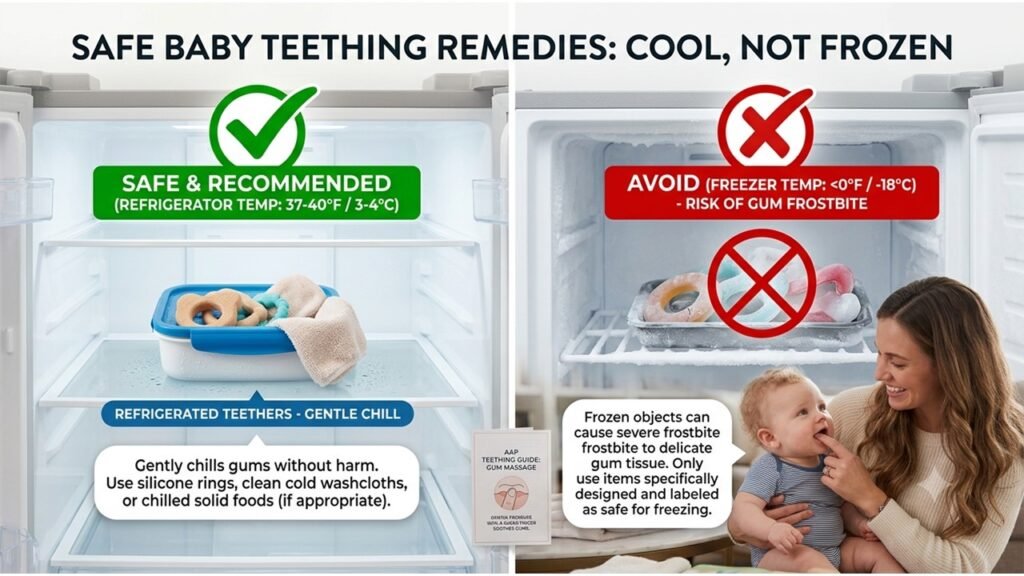
2. Baby Teething Remedies: Cold Therapy (Chilled, Never Frozen)
Cold numbs the gums and reduces inflammation. But here’s the critical part: chilled, not frozen.
Safe cold options:
- Chilled (not frozen) teething rings: refrigerate for 15 to 30 minutes.
- Cold, wet washcloth: twist it and refrigerate.
- Chilled pacifier.
- Cold spoon (for older babies).
- Chilled soft fruit in a mesh feeder: for babies over 6 months on solids.
What to avoid:
- Frozen teething rings can cause frostbite on delicate gums.
- Ice cubes or frozen pops, same frostbite risk.
- Anything dipped in sugar, you don’t want to start a cavity problem before teeth even fully emerge.
Safety Tip: Keep a few teething rings in the fridge at all times. Rotate them so you always have a cold one ready.
3. Safe Teething Toys
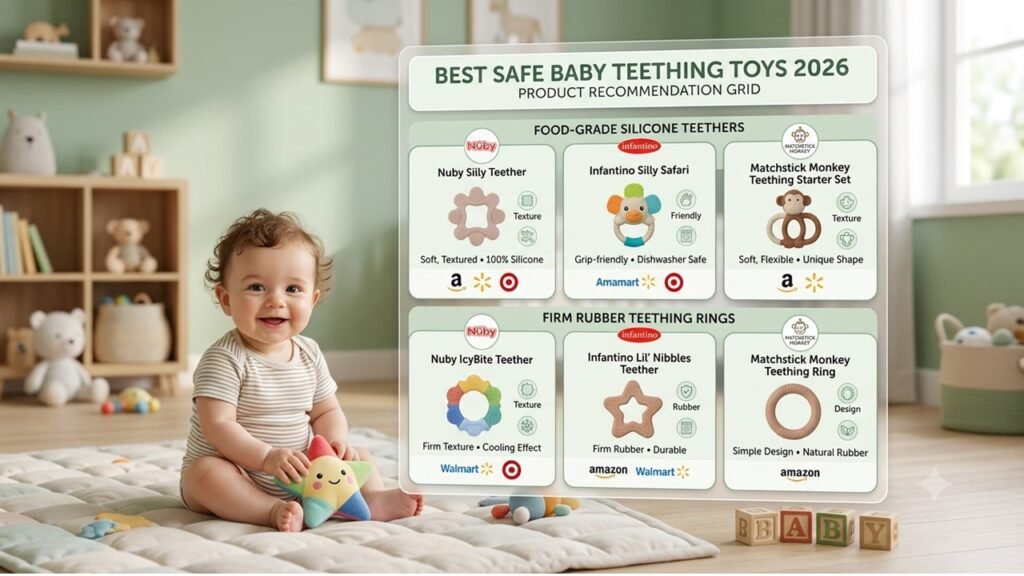
The AAP recommends choosing teething rings made of firm rubber.
What to look for when buying:
- BPA-free and phthalate-free labels
- Food-grade silicone or firm rubber
- One-piece construction, no small parts that could break off
- CPSC-compliant, meets U.S. safety standards for children’s products
- Large enough not to be a choking hazard
What to avoid:
- Liquid-filled or gel-filled teethers: they can leak into your baby’s mouth.
- Wooden teethers: splinter risk.
- Hard plastic: can be too harsh on gums.
- Any teether with small detachable parts.
Look for the CPSC certification mark. Products intended for children under 3 must meet strict ASTM F963 safety standards.
4. OTC Pain Relievers (When and How)
Sometimes, non-medication approaches just aren’t enough for baby teething remedies. And that’s okay. Here’s what you need to know.
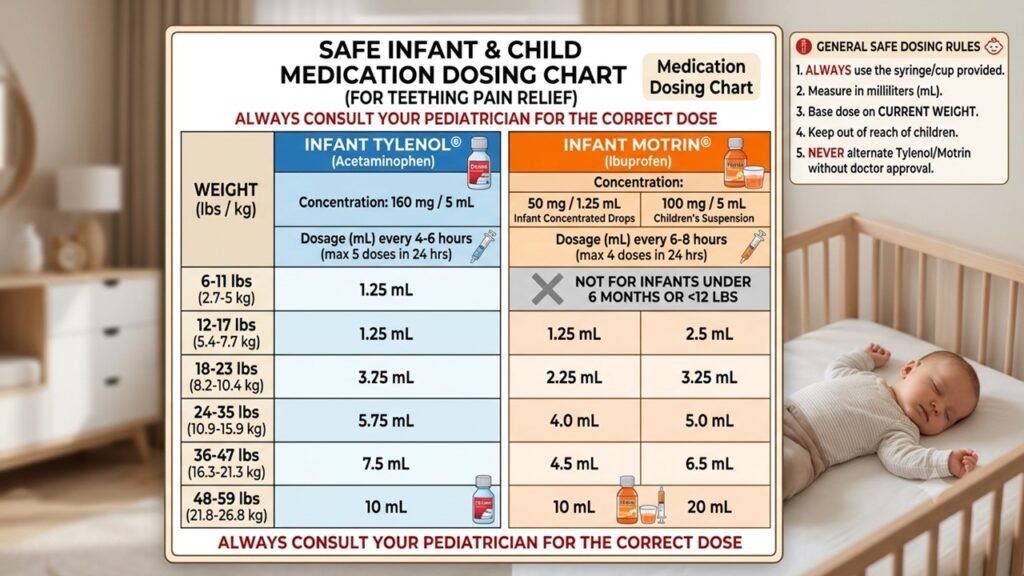
Acetaminophen (Tylenol)
The AAP recommends acetaminophen as the preferred medication for infants under 6 months:
- Dose: 3 mg/kg per dose, every 6 hours as needed
- Maximum daily: Not exceeding 15 mg/kg/day
- When to stop: After 1 to 2 days of use
- Available as: Infant drops, suppositories (if baby refuses oral meds)
Ibuprofen (Advil, Motrin)
- Age restriction: NOT recommended for infants under 6 months due to limited safety data.
- For babies 6+ months: Can be used safely for teething pain.
- May be alternated with acetaminophen for better pain control.
Important Safety Tip: Always use the dosing syringe that comes with the medication. Never use a kitchen spoon. And double-check the concentration, infant drops and children’s liquid are different strengths.
Can you alternate Tylenol and ibuprofen?
Some pediatricians allow alternating for severe pain, but the AAP recommends using one medication at a time for simplicity and safety. If you do alternate, keep a written log of what you gave and when.
5. Baby Teething Remedies: Comfort Feeding & Extra Cuddles
Never underestimate the power of connection.
- Breastfeeding is a highly effective pain reliever during teething, shown to lower pain responses and reduce crying time.
- Non-nutritive sucking (pacifier or clean finger) provides comfort.
- Skin-to-skin contact and swaddling can provide significant relief.
- Extra cuddles, sometimes that’s all they really need.
Baby Teething Products: What to Buy and Where
Our Top Recommended Teethers
| Product Type | Examples | Where to Buy |
|---|---|---|
| Food-grade silicone | Baby Banana, Matchstick Monkey | Amazon, Target |
| Firm rubber | Nuby, Infantino | Walmart, Target |
| Chilled water-filled | Nuby Chill & Chew, Munchkin | Amazon, CVS |
| Mesh feeder | Munchkin Fresh Food Feeder | Target, Walmart |
Teether Safety Checklist
Before you buy any teething product, run through this checklist:
- □ Labeled BPA-free.
- □ Made of food-grade silicone or firm rubber.
- □ One-piece with no small parts.
- □ CPSC-compliant (check the packaging).
- □ Large enough not to be a choking hazard.
- □ Not liquid-filled (unless distilled water).
- □ No gel filling.
Teething Snacks & Foods
For babies who are already on solids (usually 6+ months), chilled foods in a mesh feeder can be a game-changer:
- Chilled banana slices.
- Chilled berries (in a mesh feeder).
- Chilled cucumber sticks (supervised).
- Chilled carrot sticks (supervised).
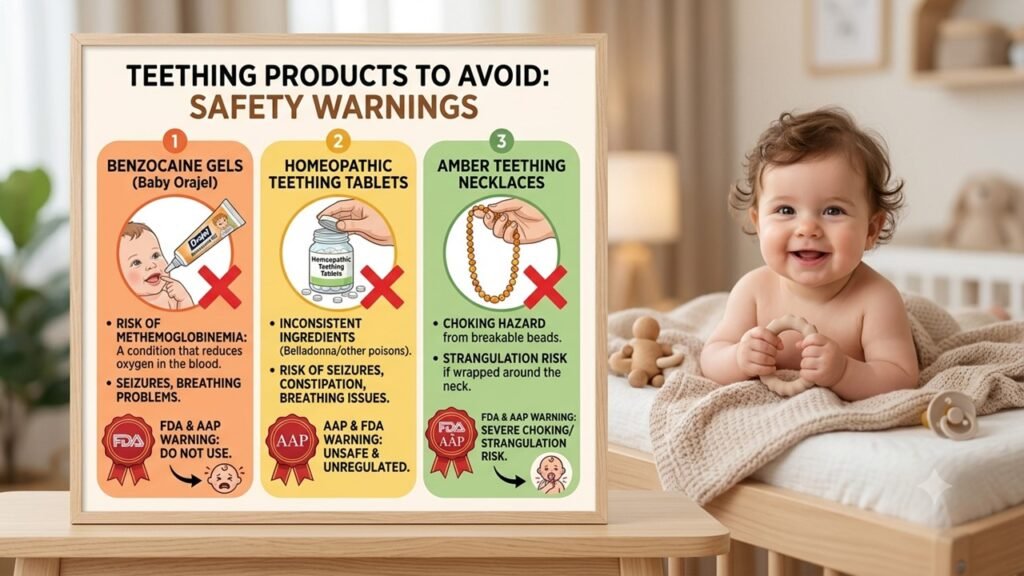
Baby Teething Remedies to AVOID (FDA & AAP Warnings)
This section could save your baby’s life. Please read carefully.
Benzocaine Gels (Baby Orajel, Anbesol, etc.)
The FDA advises parents to avoid using any topical product containing benzocaine on children under age 2.
Why?
Benzocaine can cause methemoglobinemia, a rare but life-threatening blood disorder that reduces the amount of oxygen carried in the blood. Cases have been reported even with benzocaine concentrations as low as 7.5%.
Lidocaine Products
Topical lidocaine-based teething gels carry serious risks, including seizures and respiratory arrest in infants. Avoid them completely.
Homeopathic Teething Tablets (Hyland’s, CVS, etc.)
The FDA warns that homeopathic teething tablets containing belladonna pose an unnecessary risk to infants and children.
Why?
FDA testing found that belladonna alkaloid levels varied wildly between tablets, some contained far more than the label stated. Belladonna can cause seizures, difficulty breathing, lethargy, muscle weakness, and even death.
The FDA urges consumers to dispose of any homeopathic teething tablets in their possession.
Amber Teething Necklaces
The AAP and FDA strongly warn against them.
Risks include:
- Choking.
- Strangulation.
- Mouth injury.
- Skin infection.
There is no scientific evidence that amber necklaces relieve teething pain or helpful regarding baby teething remedies.
Frozen Teethers & Ice
Frozen items can cause frostbite of the gums. Always chill, never freeze.
Aspirin
Never give aspirin to a baby or child. It’s linked to Reye’s syndrome, a rare but serious condition that can be fatal.
Nighttime Teething Management: Helping Everyone Sleep
Why Teething Hurts More at Night
When babies lie down, blood flow to the head increases, which can make gum swelling and pain feel worse. Plus, there are fewer distractions at night such as no toys, no siblings, no activity to take their mind off the discomfort.
A Bedtime Routine That Works
- Warm bath: helps relax the whole body
- Gentle gum massage: 2 minutes of pressure
- Offer a chilled teether: while reading a book
- If needed, give acetaminophen 30 minutes before bed: this gives it time to kick in
- Comfort feeding: breastfeed or offer a bottle
- Extra cuddles: skin-to-skin if possible
Safe Sleep Practices
- No amber necklaces: strangulation risk.
- No pillows to elevate the head: SIDS risk.
- No loose bedding: SIDS risk.
- Back to sleep: always.
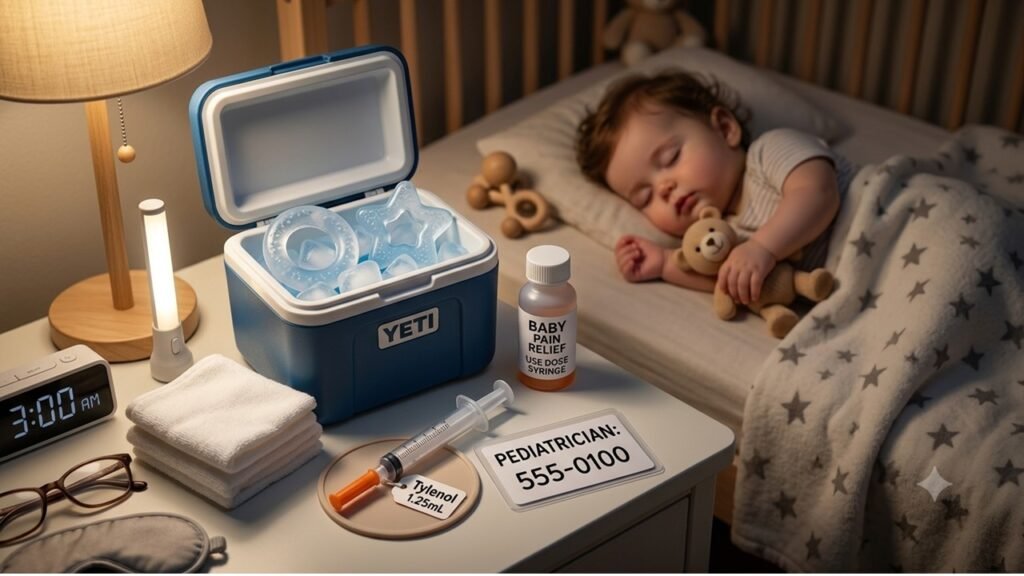
Safety Tip: Keep a chilled teether in a small cooler by the bed. If your baby wakes up in pain, you don’t have to stumble to the kitchen in the dark.
When to Call the Pediatrician
Teething is uncomfortable, but it shouldn’t be dangerous. Call your pediatrician if your baby has:
| Symptom | What It Means |
|---|---|
| Fever above 100.4°F (38°C) | Likely an infection, not teething |
| Diarrhea lasting more than 24 hours | Could be a virus or infection |
| Refusing all fluids | Risk of dehydration |
| Symptoms persisting beyond 2–3 days | May be something else |
| Signs of ear infection | Tugging ears, fever, trouble sleeping |
| Severe, nonstop crying | Could indicate a more serious problem |
If your baby has trouble breathing, seizures, or extreme lethargy, call 911 immediately.
Frequently Asked Questions About Safe Baby Teething Remedies
When do babies start teething?
Most babies get their first tooth between 6 and 10 months, though discomfort can start as early as 3 months. By age 3, all 20 primary teeth are usually in.
Can teething cause a fever?
No. Extensive studies show teething does not cause fevers above 100.4°F (38°C). A true fever means your baby may be sick, call your pediatrician.
Does teething cause diarrhea?
No. Teething does not change how your baby’s digestive system works. Diarrhea lasting more than a day could be an infection, consult your doctor.
What is the safest teething remedy for babies?
The AAP recommends starting with non-medication approaches like gum massage, chilled (not frozen) teething rings, and comfort feeding. If pain is severe, acetaminophen is the first choice for infants under 6 months.
Can I give my baby Tylenol for teething?
Yes. Acetaminophen (Tylenol) is the AAP-preferred medication for teething pain in babies under 6 months. Use a weight-based dose: 3 mg/kg every 6 hours as needed, not exceeding 15 mg/kg/day.
Can I give my baby ibuprofen for teething?
Ibuprofen (Advil, Motrin) can be used for babies 6 months and older. It is not recommended under 6 months due to limited safety data.
Can I alternate Tylenol and ibuprofen for teething?
Some pediatricians allow alternating for severe pain, but the AAP recommends using one medication at a time for simplicity and safety. Always consult your pediatrician first.
Are amber teething necklaces safe?
No. The AAP and FDA strongly warn against amber necklaces due to choking and strangulation risks. There is no scientific evidence they relieve pain.
Are homeopathic teething tablets safe?
No. The FDA warns that homeopathic teething tablets containing belladonna pose an unnecessary risk to infants. Testing found inconsistent and sometimes dangerously high levels of belladonna alkaloids.
How long does teething pain last for each tooth?
Each tooth typically causes discomfort for a few days before it breaks through. The most intense pain usually lasts 3–5 days per tooth.
When should I call the doctor for teething?
Call your pediatrician if your baby has a fever over 100.4°F, diarrhea lasting more than a day, refuses all fluids, or if symptoms persist beyond 2 to 3 days.
How can I help my teething baby sleep at night?
Try a warm bath before bed, gently massage the gums, and if needed, give a weight-based dose of acetaminophen 30 minutes before bedtime. Never use amber necklaces or elevate the crib mattress.
Conclusion: Safe Baby Teething Remedies
Teething is tough, on your baby and on you. The sleepless nights, the fussiness, the worry about whether you’re doing the right thing. It’s exhausting, and it’s completely normal to feel overwhelmed.
But here’s the good news: teething is temporary. Each tooth eventually breaks through. The crying subsides. And before you know it, your baby will be flashing you a gummy (or toothy!) grin that makes it all worth it.
Remember the key takeaways:
- Start simple: gum massage and chilled (not frozen) teethers work wonders.
- Use medication wisely: acetaminophen for under 6 months, ibuprofen for 6+ months.
- Avoid the dangers: no benzocaine, no homeopathic tablets, no amber necklaces.
- Know when to call the doctor: fever over 100.4°F, diarrhea, or persistent symptoms.
- Trust your instincts: you know your baby best.
You are doing a great job. Your baby is lucky to have you. And this too shall pass.
Did this guide helped you? Consider sharing it with another parent and drop in your comment for feedback and suggestions. You may find these articles really helpful for your baby: Newborn Baby Care Immediately After Birth, Sunscreen for Babies Under 6 Months, Baby Breathing Problems Due to Room Spray and others on this site.
Medical Disclaimer:
This article is for informational purposes only and does not constitute medical advice. Always consult your pediatrician or healthcare provider before starting any new remedy or medication for your baby. If you are concerned about your child’s symptoms, seek professional medical care immediately.