
Postpartum Nightstand Safety: 9 Life‑Saving Items to Keep on Your Nightstand After Birth (OB‑Approved)
You’ve just brought your baby home. The nursery is ready, the diapers are stacked, and you feel like you’ve thought of everything. But then 3 a.m. arrives. You’re running on empty, your body is sore, and every time you stand up, you feel dizzy. You need your pain medicines, but they’re buried somewhere in a dark drawer. The baby is crying, you’re bleeding, and getting out of bed feels genuinely dangerous.
If this hits close to home, please know: you are not alone, and this is not your fault. These feelings are a direct result of the physical and hormonal changes your body is going through.
But there’s a hidden risk you might not have considered. Data from the Centers for Disease Control and Prevention (CDC) shows that a majority of pregnancy‑related complications, about 69%, occur during the postpartum period. In fact, experts have found that most maternal deaths happen after the baby is born, with 53% occurring between a week to a full year after pregnancy. Leading health authorities, including ACOG, now officially call this vulnerable time the “fourth trimester,” recognizing the profound impact of sleep deprivation and physical exhaustion on your safety and recovery.
That’s why I have written this guide based on OB/GYN recommendations and maternal safety protocols. I’ll walk you through 9 life‑saving items to keep on your nightstand. These essentials are designed to minimize your need to get out of bed when you’re weak or half‑asleep, reducing your risk of falls and helping you spot early warning signs with a simple, actionable postpartum nightstand safety checklist that could save your life or help you avoid a scary trip to the ER.
What Should I Keep on My Nightstand for Postpartum Safety?
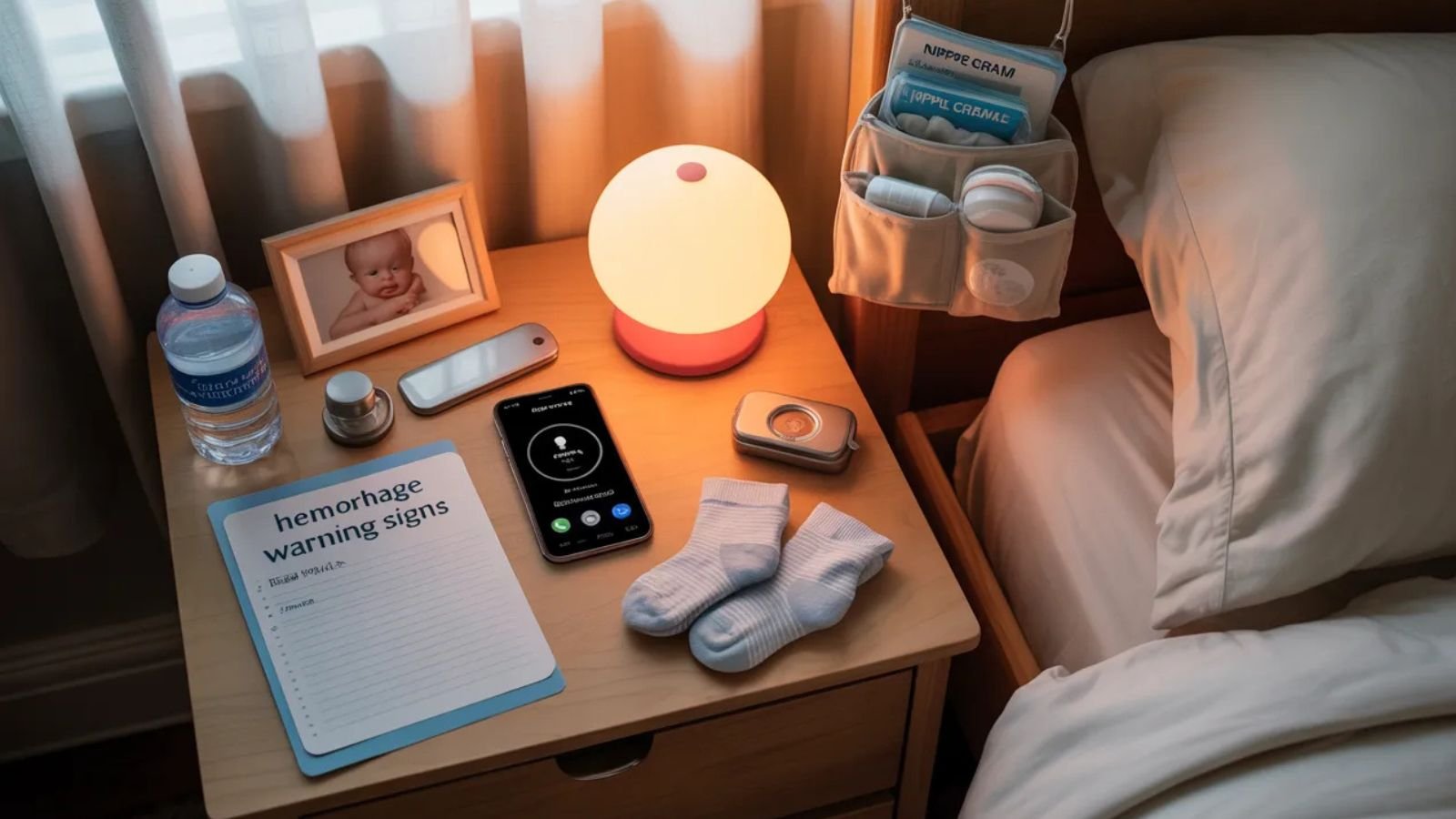
A safe postpartum nightstand should have nine essential items within arm’s reach to prevent falls, manage emergencies, and support recovery. Here is a quick postpartum nightstand safety checklist you can use right away:
- Red‑light lamp: Protects newborn eye health and preserves your night vision for safe midnight feedings.
- Phone with emergency contacts: Always charged and reachable for immediate help.
- Hemorrhage warning sheet: A laminated card listing emergency signs. The CDC reports that 14% of pregnancy‑related deaths are due to excessive bleeding, so acting fast is critical.
- Breastfeeding supplies: Burp cloths, and a small flashlight to avoid dangerous late‑night searching.
- Pain medications + pill organizer: Kept secure and taken on a strict schedule.
- Locking water bottle: Prevents spills and keeps you hydrated to reduce dizziness and fainting risk.
- Baby monitor: Positioned facing you, with backup batteries nearby for safe room‑sharing.
- Medication schedule + pen: A printable log to track every dose when you’re sleep‑deprived.
- Grip slippers + movement reminder: Slippers with non‑slip soles near the bed, plus a note that says “move slowly, sit before standing.

Postpartum Nightstand Safety: Why Your Bedside Setup Matters After Birth?
After delivering a baby, your body goes through dramatic changes. You may have lost a significant amount of blood. You might be recovering from an epidural, spinal block, or C‑section anesthesia. Your abdominal muscles are weak. On top of that, you’re sleeping in 45‑minute stretches while caring for a newborn who needs you around the clock.
This perfect storm of exhaustion, pain, and physical instability puts you at a high risk for falls, especially at night when you get up to use the bathroom, tend to the baby, or reach for medication. A thoughtfully arranged postpartum nightstand safety checklist can be the difference between a safe recovery and a serious injury.
Think of your nightstand as your command center. It should hold everything you might need between the hours of 10 p.m. and 6 a.m. without requiring you to walk across a dark room, bend down low, or fumble through a messy drawer. That’s why I’ve broken this postpartum nightstand safety checklist into nine clear, actionable items.
9 Life‑Saving Items to Keep on Your Nightstand After Birth (OB‑Approved)
Let’s dive into the actual postpartum nightstand safety checklist. I recommend printing this section and keeping it on your bedside table until you’ve built the habit.
1. Red‑Light Nightstand Lamp for Newborn Eye Safety
A regular white lamp or overhead light can be jarring at 3 a.m. It hurts your eyes, wakes the baby further, and makes it harder to fall back asleep. A red‑light lamp preserves night vision and does not suppress melatonin production, so you can feed, change, and medicate without fully waking your brain. Plus, red light is gentler on a newborn’s developing eyes. Add this to your postpartum nightstand safety checklist to protect both sleep cycles.
2. Emergency Phone Placement Postpartum (Always Within Reach)
Your phone is your lifeline. But if it’s on the floor, across the room, or buried under a pile of burp cloths, it might as well be on Mars. Position your phone on the nightstand with the screen facing up, plugged into a charger, and with emergency contacts already saved. If you start hemorrhaging, feel like you’re going to faint, or notice baby is struggling to breathe, you need to dial immediately. This simple step is non‑negotiable on any postpartum nightstand safety checklist.
3. Postpartum Hemorrhage Warning Signs (Keep This Cheat Sheet on Your Nightstand)
Postpartum hemorrhage (PPH) can happen suddenly, even days after delivery. Warning signs include:
- Soaking more than one pad per hour
- Passing blood clots larger than a golf ball
- Dizziness, blurred vision, or feeling like you’ll faint
- Racing heart or sudden paleness
Write these on a small index card or print a laminated version. Tape it to your nightstand or keep it under your lamp. I call this the “red flag card,” and it’s the most overlooked part of a postpartum nightstand safety checklist. Review it every night so you’re ready to act fast.
4. Breastfeeding Supplies Within Reach to Prevent Middle‑of‑Night Falls
When your baby wakes at 2 a.m. hungry, your first instinct is to jump up and grab a burp cloth or nipple cream from the bathroom. Keep a small caddy or a drawer organizer on your nightstand with:
- 2‑3 burp cloths.
- Nursing pads.
- A small clip‑on reading light or mini flashlight.
This keeps you safely in bed and dramatically reduces the number of times you get up when you’re dizzy or sleep. Every strong postpartum nightstand safety checklist includes a nursing station.
5. Postpartum Pain Relief Accessibility (Safe Storage for OTC & Postpartum Medicines)
Whether you had a vaginal birth with tearing or a C‑section, you will likely be sent home with pain medication. Never keep loose pills on your nightstand where they could spill or be accessed by a curious toddler or pet later on. Instead, use a daily pill organizer with labeled compartments for morning and night.
Set phone alarms for your next dose, and after taking it, mark the time on your medication log. This small habit prevents accidental double‑dosing and ensures you stay ahead of the pain. It’s a crucial line item on your postpartum nightstand safety checklist.
6. Bedside Hydration for Breastfeeding Moms (Why a Locking Water Bottle Saves Lives?)
Dehydration can cause dizziness, low blood pressure, fainting, and even uterine cramping (which can mimic hemorrhage). Breastfeeding moms need an extra 16 to 24 ounces of water per day just to keep up with milk production. Keep a large, insulated water bottle with a locking lid on your nightstand. A locking lid is essential because one spilled gallon of water on your phone, lamp, or medication organizer could be a disaster. Add “locking water bottle” to your postpartum nightstand safety checklist today.
7. Baby Monitor Placement for Safe Room Sharing (Nightstand Edition)
If your baby is sleeping in a separate room, you need a baby monitor facing you on the nightstand. Keep it at eye level with the volume turned up but not ear‑splitting. Store backup batteries in the nightstand drawer. If you’re room‑sharing (baby in a bassinet next to the bed), you may not need a monitor, but you should still keep a small flashlight to check on baby without turning on bright lights.
8. Postpartum Medication Schedule on Nightstand (Avoid Double Dosing in the Dark)
Sleep deprivation is real. That’s why a simple medication log is part of my postpartum nightstand safety checklist. You can use a small notebook or a printed weekly chart. Each time you take a dose, put a checkmark. Also note the time. Keep a pen taped to the nightstand so you never have to search for it. This is a low‑tech, high‑impact habit that prevents accidental overdose.
9. Blood Clot Precautions Postpartum (Footwear & Movement Reminders on Your Nightstand)
Blood clots (deep vein thrombosis or pulmonary embolism) are a rare but serious postpartum complication. The risk is highest the first six weeks after delivery, especially after C‑section. To prevent clots, you need to move gently, every couple of hours. Keep a pair of grip slippers or non‑skid socks right next to your nightstand. Then place a sticky note that says: “Walk to bathroom every 2 hours. Move ankles in bed.” This tiny reminder, part of your postpartum nightstand safety checklist, could literally save your life.
Postpartum Nightstand Must‑Haves for C‑Section Recovery
If you had a C‑section, your postpartum nightstand safety checklist needs a few extra layers.
How to Arrange Nightstand Items Without Bending or Twisting?
After a C‑section, bending at the waist is painful and can strain your incision. Keep your nightstand items at mattress height or higher. Use a small shelf or a tiered rolling cart next to the bed. Avoid low drawers or floor storage at all costs.
Safe Transfer from Bed to Bathroom (Post‑Birth)
Print out a small card that says: Roll to your side. Push up with arms. Sit for 15 seconds. Stand. Tape this to your nightstand. This slow, intentional movement protects your incision and prevents falls.
Safe Bedside Caddy for New Moms: How to Organize Without Clutter?
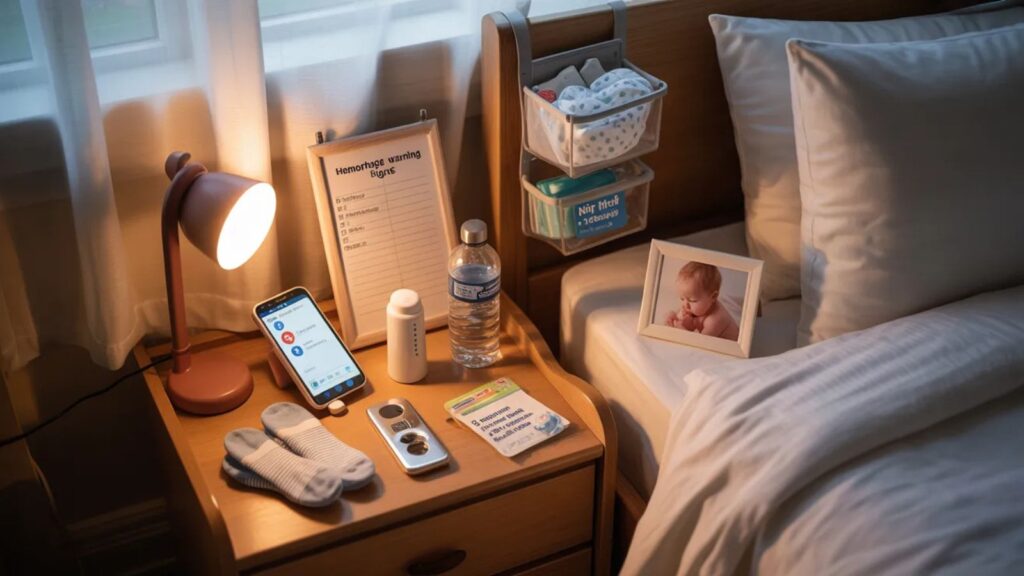
A single nightstand surface can get cluttered fast. I recommend a hanging bedside caddy with clear vinyl pockets. Hang it over the side of your nightstand or attach it to your headboard. Here’s how to organize it using your postpartum nightstand safety checklist:
- Top pocket: Phone, medication log, pen, red flashlight.
- Middle pocket: Hemorrhage warning card, lip balm, snacks.
- Bottom pocket: Extra pads, disposable underwear, burp cloths.
Keep only the essentials. Every item should serve a safety or comfort purpose.
Keeping a Snack Station on Your Nightstand to Avoid Drowsy Kitchen Trips
Low blood sugar can make you dizzy and weak. Keep a small stash of non‑perishable, one‑handed snacks in your nightstand drawer: granola bars, dried mango, crackers, or nuts. Avoid messy or crumbly foods that could attract ants. This snack station is a gentle addition to your postpartum nightstand safety checklist that many moms forget.

Postpartum Nightstand Organization for Emergency Access (A Room‑by‑Room Safety Checklist)
Here is a quick room‑by‑room version of your postpartum nightstand safety checklist to help you visualize exactly where everything goes:
- On the nightstand surface: Red lamp, phone, locking water bottle, baby monitor, hemorrhage warning card.
- In the top drawer: Pill organizer, medication log, pen, snacks, mini flashlight.
- In the middle drawer (if available): Extra pads, disposable underwear, burp cloths, nipple cream.
- On the floor next to bed: Non‑slip mat, grip slippers, motion‑sensor nightlight plugged in low.
- Taped to the nightstand side: “Sit before standing” and “Walk every 2 hours” reminders.
Take 10 minutes today to set this up. Future you will be so grateful.
Postpartum Nightstand for Moms with Limited Mobility for High‑Safety
Using a Bedside Caddy with a Long Handle
Some moms after C‑section or severe tearing cannot twist or reach far. Look for a bedside caddy that swings out over the mattress or attach a grabber tool to your nightstand so you can pull items closer.
Pre‑Cut Straws & Sealed Snacks to Avoid Getting Up
Open all snack wrappers before bed and place them in a small bowl. Use pre‑cut straws for your water bottle so you don’t have to sit fully upright to drink. These tiny adaptations keep you in bed longer, which is exactly where you need to be to heal.

Frequently Asked Questions: Postpartum Nightstand Safety
Can I Use a Regular Bedside Table, or Do I Need a Special Caddy?
A regular bedside table works perfectly as long as it is at mattress height and has at least one drawer or a flat surface for your postpartum nightstand safety checklist items. A caddy is helpful if you have limited space or need to keep things organized.
What Should I Not Keep on My Postpartum Nightstand?
Never keep hot liquids (coffee, tea) on your nightstand, one spill could burn you or baby. Avoid loose pills, sharp objects (scissors, open safety pins), and clutter that could fall and become a tripping hazard.
How Often Should I Reorganize My Nightstand During the Fourth Trimester?
Once a week, go through your postpartum nightstand safety checklist:
-Throw away old snack wrappers.
-Restock pads and diapers.
-Check that your hemorrhage warning card is still readable.
-Recharge your phone and flashlight.
-Update your medication log with new doses.
What Are the Bedside Essentials for Postpartum?
The nine bedside essentials are a red‑light lamp, phone within reach, hemorrhage warning card, breastfeeding supplies, pain medications in a pill organizer, locking water bottle, baby monitor, medication log with pen, and non‑slip grip socks. Besides; bin, or diaper caddy with a generous supply of diapers, wipes, hand sanitizer, diaper ointment, and baby lotion will also aid to safety.
What Must be Inside the Bedside Cart for Newborn?
A bedside cart for a newborn must include diapers, wipes, burp cloths, swaddles, a change of clothes, nipple cream, a nightlight, and emergency contact info.

Conclusion: Postpartum Nightstand Safety
Let’s bring it all together. Your body just accomplished something miraculous, but it’s also vulnerable right now. The postpartum nightstand safety checklist I’ve shared with you isn’t about perfection, it’s about protection. It’s about stacking the odds in your favor so that on your hardest, sleepiest nights, you don’t have to take unnecessary risks. Remember the three pillars:
- Life‑saving items: Hemorrhage card, phone, meds.
- Fall prevention: Red light, non‑slip mat, grip socks, motion nightlight.
- C‑section & mobility adaptations: No bending, reachable caddy, slow transfer cues.
Most importantly, share this post with another new mom. Forward it to a friend who is due next month. Post it in your bump group. Because a safe nightstand means safer nights for both mama and baby. Do read more useful articles from this site: Postpartum Stair Safety Tips, Postpartum Home Hazards, Postpartum Home Care Checklist and stay connected.


1 Response
[…] frequently used supplies nearby: Setting up a safer postpartum bedside area keeps you safe and comfortable. Store essentials on the main floor where you rest, feed your baby, […]