Lead in Spices During Pregnancy: Safe Brands & Blood Test Guide (2026)

It’s 11 p.m., you’re 28 weeks pregnant, and you’re standing in front of your spice rack with your phone in one hand.
Somewhere in that little row of jars, the turmeric you stir into daal, the cinnamon you sprinkle on oatmeal, the thyme you’ve been using all winter, there might be lead. You read a headline. You saw a recall. And now you’re holding a half-empty jar of imported turmeric, wondering whether you’ve been quietly exposing your baby for months.
Take a breath. You do not need to throw out your entire spice rack tonight.
Here’s what’s true: lead in spices during pregnancy is a real concern. The FDA has issued repeated alerts for ground cinnamon, and Consumer Reports found that roughly one in three tested spice products carried concerning heavy-metal levels. But the risk isn’t spread evenly across every jar in your kitchen. It concentrates in a handful of specific spices, from specific supply chains, and it depends heavily on how much you use and for how long.
In the next few minutes, you’ll learn which four spices carry the highest risk during pregnancy (and why turmeric is at the top of that list), the exact blood lead numbers your OB is looking at, 3.5 and 5 µg/dL, and whether you should be asking for a test.
You’re not overreacting. You’re paying attention. Let’s put that attention to work.
Is Lead in Spices During Pregnancy Really a Risk?
Yes, lead in spices is a real but dose-dependent risk during pregnancy. The FDA has issued repeated public health alerts for ground cinnamon, and Consumer Reports found that roughly one-third of 126 tested spice products carried concerning heavy-metal levels. The risk is highest with imported ground turmeric, cinnamon, thyme, and oregano, and it depends on how much you use and for how long.
What the FDA and Consumer Reports Testing Actually Shows?
The FDA’s ground cinnamon alert has been updated repeatedly. As of the September 28, 2026 update, the alert includes Lior Gourmet Spices (2.18 ppm lead), Lucky Foods Brand (3.00 and 4.17 ppm), BaiLiFeng (10.7 ppm), DEVI (2.92 ppm), and Venzu Traders (3.00 ppm). Earlier entries have included products at even higher concentrations, El Servidor at 20 ppm, for example.
Consumer Reports’ landmark testing of 126 herbs and spices from 38 brands found that 40 products had heavy-metal levels high enough to pose a health concern for children when regularly consumed in typical serving sizes, and most raised concern for adults too.
The most striking findings:
- All thyme and oregano products tested had levels Consumer Reports experts called concerning.
- In 31 products, lead levels exceeded the maximum amount anyone should have in a day.
- Brand name, “organic,” and “packed in USA” labels did not predict lead levels, none of them were reliable safety signals.
A 2025 test in Lancaster, Pennsylvania, found that 90% of spices sold in stores or donated by homeowners contained heavy metals, and over 40% had lead levels exceeding daily recommended limits.
Why Pregnancy is a Uniquely Sensitive Window?
Lead crosses the placenta. It doesn’t stay in your body and wait, it reaches your baby.
The American Academy of Pediatrics notes that lead exposure during pregnancy is associated with spontaneous abortion, low birth weight, reduced fetal growth, and hypertensive complications of pregnancy. The World Health Organization specifically links lead exposure in pregnant women to reduced fetal growth and preterm birth.
And here’s the number that matters most: the FDA has historically used 25 micrograms per day as the daily lead intake limit for pregnant women, lower than the 75 mcg/day limit for other adults. That’s a tight budget, and it’s why a single high-lead spice can matter more than you’d expect.
Which Spices Are Highest Risk for Lead During Pregnancy?
The highest-risk spices in pregnancy are ground turmeric, ground cinnamon, thyme, and oregano, turmeric because of documented lead chromate adulteration, cinnamon because of repeated FDA alerts, and thyme and oregano because every product Consumer Reports tested in those categories was concerning.
Turmeric: The Adulteration Problem
Turmeric is the spice that should worry you most, not because turmeric itself is dangerous, but because of what sometimes gets added to it.
Why Lead Chromate is Added to Turmeric?
Lead chromate is a bright yellow pigment. In some South Asian supply chains, it has been intentionally added to turmeric powder to make the color more vivid and the product more appealing.
This isn’t a trace contamination issue. It’s adulteration and it produces lead concentrations far higher than anything that occurs naturally in soil.
A scoping review published in 2025 estimated the adulteration rate for turmeric products at 20.0%, with lead chromate reported mainly from Southern Asia.
What to do?
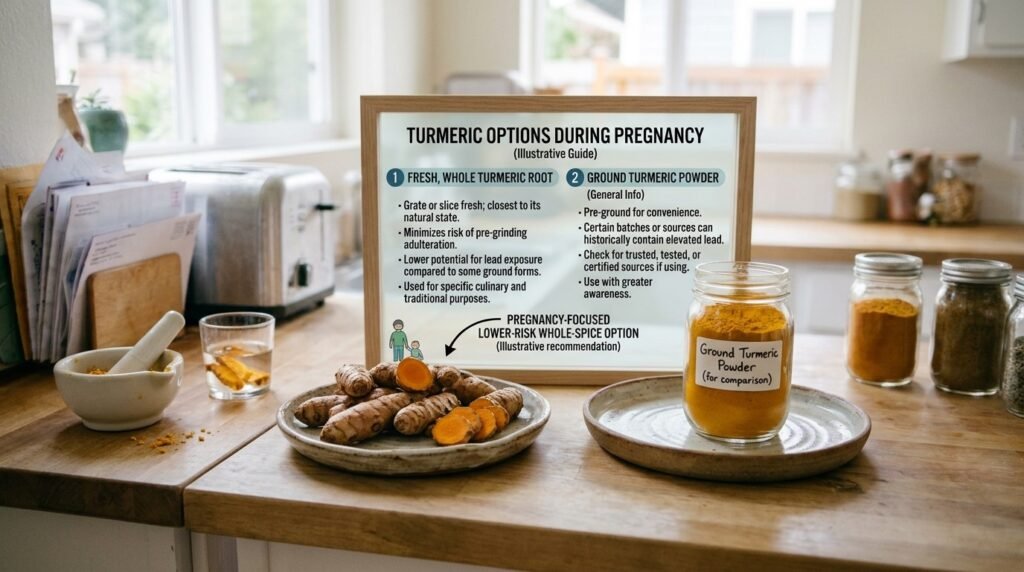
- Use fresh turmeric root where possible, it avoids the powder adulteration pathway entirely.
- If you use ground turmeric, choose a brand that publishes third-party heavy-metal testing or a certificate of analysis (COA).
- Limit daily use of ground turmeric rather than eliminating it, a small amount in cooking is a different exposure scenario than a daily high-dose supplement.
Cinnamon: FDA Alerts and Brand Variability
Cinnamon is the spice most covered in the news, and for good reason: the FDA has issued alerts for more than two dozen brands of ground cinnamon since 2024.
The FDA alert list (updated 2026)
The current FDA alert includes:
- Lior Gourmet Spices: 2.18 ppm
- Lucky Foods Brand: 3.00 and 4.17 ppm
- Venzu Traders: 3.00 ppm
- DEVI: 2.92 ppm
- BaiLiFeng: 10.7 ppm
The FDA advises consumers to stop using and dispose of these products and to check their homes because spices have a long shelf life.
“Best to Use” Vs. “Do Not Use” Brands
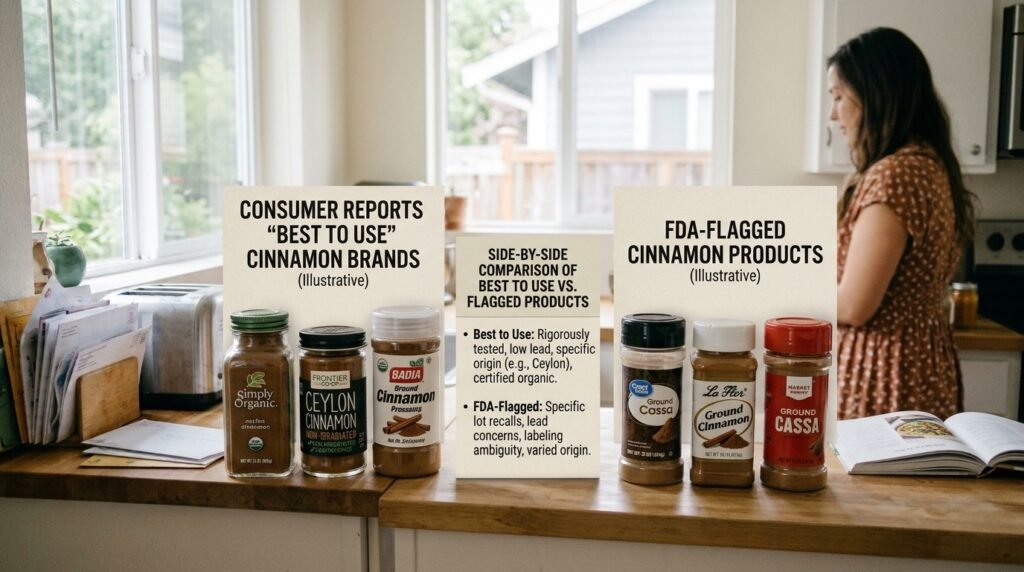
Consumer Reports classified cinnamon products into risk categories based on tested lead levels. The “Best to Use” brands included:
- 365 Whole Foods Market Ground Cinnamon: 0.12 ppm, can use up to 2 teaspoons daily
- Loisa Organic Cinnamon: 0.04 ppm, can use up to 5¾ teaspoons daily
- Morton & Bassett San Francisco Organic Ground Cinnamon
- Sadaf Cinnamon Powder and Sadaf Seven Spice blend
The highest-lead brands tested, including Paras, EGN, and Mimi’s Products, were classified as “Do Not Use.”
Cassia Vs. Ceylon: Does Variety Matter?
Most cinnamon sold in the U.S. is Cassia, not Ceylon. But the lead risk is driven by supply-chain contamination and adulteration, not the botanical variety itself. Switching to Ceylon cinnamon does not automatically solve the problem if the product still comes from an unverified supply chain.
Thyme and Oregano: The Category-Wide Gap
Every single thyme product and every single oregano product Consumer Reports tested was classified as concerning. There was no “No Concern” option in either category, not a single brand passed.
That means for thyme and oregano, brand selection cannot protect you. The category itself is the problem.
What to do?
Switch to fresh thyme and fresh oregano. They’re widely available in U.S. grocery stores, they’re not subject to the same drying and supply-chain contamination pathways, and they deliver better flavor anyway.
Cumin, Paprika, Chili Powder and Ginger: Mixed Results
These categories had both concern-level and no-concern products. Consumer Reports found that in around half of paprika and turmeric brands, levels were concerning, but not all.
Buy mainstream sealed brands, rotate rather than relying on a single brand, and don’t assume any one product is safe without checking.
Lower-Risk Spices for Pregnancy
The good news is that a whole category of spices performed well.
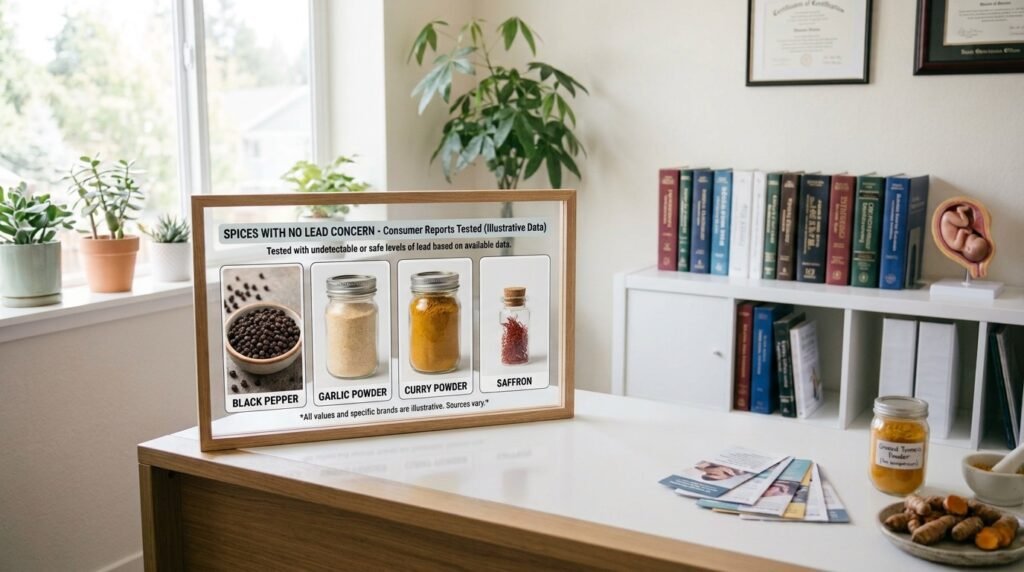
Consumer Reports found that black pepper, coriander, curry powder, garlic powder, saffron, sesame seeds, and white pepper all fit the “No Concern” category, and in these categories, every brand tested was below the concern threshold.
You can keep using these with confidence.
A Pregnancy Spice Risk Table
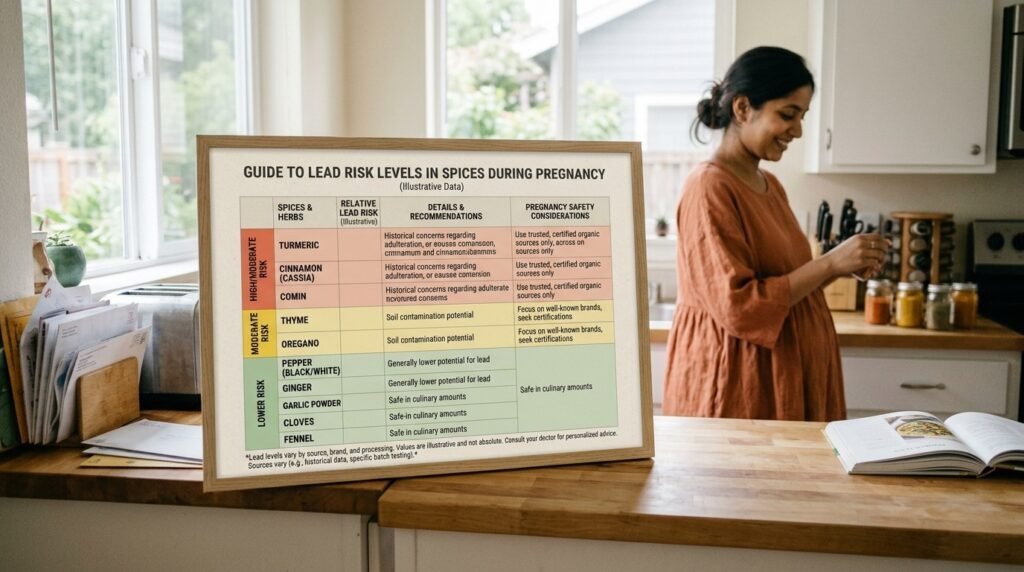
| Spice | Pregnancy risk level | Primary concern | Practical action |
|---|---|---|---|
| Ground turmeric | High | Lead chromate adulteration | Fresh root or third-party-tested powder; limit daily use |
| Ground cinnamon | Variable | FDA alerts; brand-dependent | Check FDA list; use “Best to Use” brands; cap at ¼ tsp/day |
| Thyme / oregano | High | Category-wide contamination | Switch to fresh herbs |
| Cumin / paprika / chili powder / ginger | Moderate | Mixed testing results | Mainstream sealed brands; rotate |
| Black pepper / garlic / curry / saffron | Lower | No concern in CR testing | Standard use reasonable |
How Does Lead Get Into Spices?
Lead gets into spices in two ways: naturally from soil during growing and drying, and intentionally through adulteration, most notably lead chromate added to turmeric to enhance color. Adulteration produces far higher concentrations than background soil contamination and is the primary driver of the highest-risk products.
Natural Soil Contamination Vs. Intentional Adulteration
Lead occurs naturally in soil, and plants can absorb it through contaminated soil or water. Open-ground drying can also introduce contamination.
But the highest concentrations come from intentional adulteration, lead chromate in turmeric, and in some cases lead compounds used in other spice supply chains. This is illegal, dangerous, and responsible for the most alarming product tests.
How Much Lead in Spices During Pregnancy Is Dangerous?
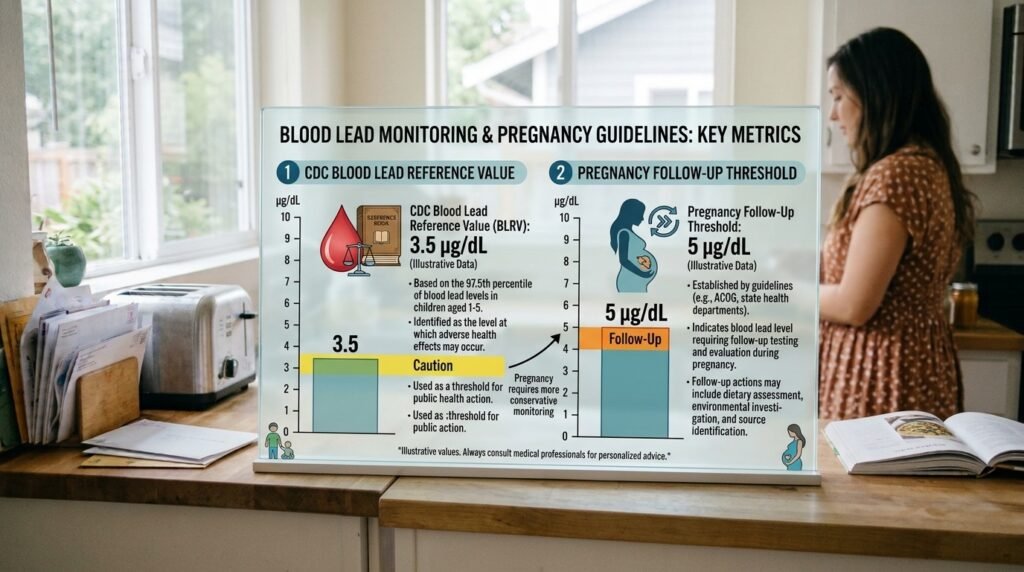
The CDC uses 3.5 µg/dL as the blood lead reference value for identifying elevated exposure, but for pregnant women, follow-up and source investigation are initiated at 5 µg/dL. The National Toxicology Program has concluded that even levels below 5 µg/dL can reduce fetal growth.
The Three Numbers Every Pregnant Reader Should Know
3.5 µg/dL: The Reference Value
The CDC’s blood lead reference value (BLRV) is 3.5 micrograms per deciliter. Capillary screening results at or above this level should be confirmed with a venous blood draw.
5 µg/dL: The Pregnancy Action Level
For pregnant women aged 18 and older, the CDC recommends clinical follow-up and case management when blood lead levels are at or above 5 µg/dL. State health departments report pregnant women at this threshold for follow-up and assessment.
No Known Safe Level
The CDC states that any amount of lead in the blood means exposure. The clinical goal in pregnancy is to minimize exposure, not to reach a “safe” threshold.
What About the USPSTF Recommendation Against Routine Screening?
The U.S. Preventive Services Task Force does not recommend routine blood lead testing for pregnant people who don’t have symptoms. The Task Force concluded that the evidence is insufficient to assess the balance of benefits and harms of screening in asymptomatic pregnant people.
But that is not the same as saying no one should be tested.
Risk-based testing is appropriate when a specific exposure source is identified. New York State health guidance specifically advises a blood test discussion for anyone who uses imported spices and Ayurvedic medicines.
That nuance matters: it prevents unnecessary anxiety for low-risk pregnancies while making sure high-exposure pregnancies don’t slip through.
Should You Get a Blood Lead Test While Pregnant?
You should ask your OB about a blood lead test if you regularly use imported ground spices (especially turmeric or cinnamon), use Ayurvedic or traditional remedies, live in a pre-1978 home, or have other lead exposure risks. Routine testing is not recommended for everyone, but risk-based testing is appropriate when a specific exposure source is identified.
Who Should Ask for a Test?
- Imported spice use, especially turmeric, cinnamon, cumin, or multi-spice blends.
- Ayurvedic, herbal, or traditional remedies, New York State specifically flags this.
- Pre-1978 housing with peeling paint or ongoing renovation.
- Imported pottery, cookware, or cosmetics (kohl, surma, sindoor).
- Occupational exposure or a partner with take-home lead exposure.
- Recent immigration from a country with higher environmental lead exposure.
Who May Not Need a Test?
Asymptomatic pregnant people with no identified risk factors, consistent with USPSTF guidance.
What your blood lead result means
| Result | What it means in pregnancy | Recommended next step |
|---|---|---|
| Below 3.5 µg/dL | Below the reference value | Reduce ongoing exposure; retest only if new risk emerges |
| 3.5 to 4.9 µg/dL | Above reference value but below pregnancy action level | Identify and eliminate sources; discuss retesting with OB |
| 5 to 9 µg/dL | At or above pregnancy action level | Source investigation; repeat testing; clinical follow-up |
| 10 µg/dL or higher | Significantly elevated | Urgent clinical management; specialist involvement |
What Happens If Your Level is Elevated?
The first-line intervention is source identification and elimination, not medication.
- Your provider will ask about spice use, water sources, home age, occupational exposures, and imported products.
- Repeat testing is used to confirm and monitor.
- Chelation is reserved for severe cases and is not a routine pregnancy intervention. Do not request chelation based on dietary spice exposure alone, it is not appropriate for low-level exposure and carries risk.
What to Do If You’ve Already Eaten High-Risk Lead Spices During Pregnancy?
If you have already eaten imported turmeric, cinnamon, or other high-risk spices during pregnancy, do not panic. The first step is to stop using the alerted product, check your pantry against the current FDA list, and mention your spice use at your next prenatal visit so your OB can decide whether a blood lead test is appropriate.
Step 1: Stop the Source
Discard any product named on the FDA ground cinnamon alert list. Stop using unverified imported ground turmeric and switch to fresh root or a third-party-tested brand.
Step 2: Check Your Pantry Against Current Alerts
Spices have long shelf lives, so a product you bought a year ago could still be within its best-by date and still be subject to a recall. Check the back of your cabinet, not just your most recent grocery haul.
Step 3: Talk to Your OB at Your Next Visit
Use a script:
“I’ve been using [brand/spice] regularly during pregnancy. It’s on the FDA alert list / it’s an imported ground spice. Should I have a blood lead test?”
Bring the product name, approximate frequency of use, and how long you used it.
Step 4: Understand Why Past Exposure is Usually Manageable
Risk depends on dose, duration, body size, and nutritional status. Prolonged ongoing exposure is the primary concern, and stopping the source is the most important intervention.
The FDA’s own guidance is clear: if there’s suspicion of elevated lead exposure, talk to your healthcare provider, most people have no obvious immediate symptoms.
Safe Spice Brands and Alternatives for Pregnancy
Consumer Reports’ “Best to Use” cinnamon brands include 365 Whole Foods Market and Loisa Organic, while Paras, EGN, and Mimi’s Products were among the highest-lead brands tested. For turmeric, fresh root is the lowest-risk option; for thyme and oregano, fresh herbs are preferable to any dried product.
Cinnamon Brands Consumer Reports Rated “Best to Use”
- 365 Whole Foods Market Ground Cinnamon: 0.12 ppm
- 365 Whole Foods Market Organic Ground Cinnamon: 0.02 ppm
- Loisa Organic Cinnamon: 0.04 ppm
- Morton & Bassett San Francisco Organic Ground Cinnamon
- Sadaf Cinnamon Powder and Sadaf Seven Spice blend
Cinnamon Brands to Avoid
- Paras, EGN, and Mimi’s Products had the highest lead levels in Consumer Reports’ testing.
- Lior Gourmet, Lucky Foods, DEVI, BaiLiFeng, Venzu Traders, and Wise Wife appear on the current FDA alert.
Turmeric: Fresh Root Vs. Tested Powder
Fresh turmeric root avoids the adulteration risk that affects ground powder. If you use powder, look for brands that publish certificate of analysis (COA) or third-party heavy-metal testing.
Thyme and Oregano: Fresh is the Safest Swap
Since all tested dried thyme and oregano products were concerning, fresh herbs are the clear alternative. This is one category where brand loyalty cannot protect you.
Lower-Risk Spices You can Keep Using
Black pepper, garlic powder, curry powder, saffron, sesame seed, white pepper, and coriander all fit Consumer Reports’ “No Concern” category, and in these categories, every brand tested was below the concern threshold.
When to Call Your Doctor
Call your OB or midwife if you have used a product on the FDA alert list regularly, if you have used imported turmeric or Ayurvedic remedies throughout pregnancy, or if you have other lead exposure risks such as a pre-1978 home renovation.
Exposure-Related Reasons to Call
- Regular use of an FDA-alerted cinnamon product.
- Daily use of imported ground turmeric or multi-spice blends.
- Use of Ayurvedic, herbal, or traditional remedies, especially for pregnancy nausea.
- Living in or renovating a pre-1978 home.
- Use of imported pottery, cookware, or cosmetics.
Symptom-Related Reasons to Call
Symptoms of lead exposure can include abdominal pain, constipation, fatigue, headache, and irritability, but these are nonspecific, and most low-level exposure is asymptomatic. Do not wait for symptoms if you have a known exposure source.
What to Say When You Call?
“I’ve been using [product] and I’m concerned about lead exposure. It is [on the FDA alert list / an imported ground spice]. I’d like to discuss whether a blood lead test is appropriate.”

Frequently Asked Questions: Lead in Spices During Pregnancy
Which spices should I avoid during pregnancy because of lead?
The highest-risk spices are ground turmeric, ground cinnamon, thyme, and oregano. Turmeric carries a documented lead chromate adulteration risk, cinnamon has repeated FDA alerts, and every thyme and oregano product Consumer Reports tested was concerning. Check the current FDA alert list and switch these categories to fresh or verified alternatives.
Is turmeric safe during pregnancy?
Fresh turmeric root is lower-risk than ground turmeric powder. Ground turmeric is the spice most associated with lead chromate adulteration, and almost half of turmeric products in Consumer Reports’ testing were concerning. If you use ground turmeric, choose a brand with published heavy-metal testing and avoid daily high-dose use.
How does lead get into spices?
Lead gets into spices through soil contamination during growing and drying, and through intentional adulteration, most notably lead chromate added to turmeric to brighten its color. Adulteration produces much higher lead concentrations than background soil exposure and is the primary driver of the highest-risk products.
Is organic cinnamon safer from lead?
No, organic labeling did not predict lower lead levels in Consumer Reports’ testing. Brand name and “packed in USA” labeling also failed to predict safety. The reliable differentiators are third-party testing, supply-chain transparency, and FDA alert status, not organic certification.
What blood lead level is dangerous in pregnancy?
The CDC’s reference value is 3.5 µg/dL, but for pregnant women, follow-up and source investigation begin at 5 µg/dL. The National Toxicology Program concluded that even levels below 5 µg/dL can reduce fetal growth. Any detectable lead means exposure, the goal is to minimize it.
Should I get a blood lead test while pregnant?
Not routinely, the USPSTF does not recommend universal screening for asymptomatic pregnant people. But you should ask for a test if you regularly use imported spices, Ayurvedic remedies, or have other lead exposure risks such as a pre-1978 home.
Does cooking or washing remove lead from spices?
No. Lead is a heavy metal element, it does not degrade with heat, dissolve in water, or rinse away. You cannot “clean” lead out of a contaminated spice. The only effective risk-reduction strategy is to reduce or replace the source.
I already ate imported spices during pregnancy, what should I do?
Stop using the product, check whether it appears on the FDA alert list, and mention your spice use at your next prenatal visit. Risk depends on dose and duration, and stopping the source is the most important step. Do not request chelation based on dietary spice exposure alone, it is not appropriate for low-level exposure.
Are whole spices safer than ground spices during pregnancy?
Generally, yes. Whole spices are less likely to be adulterated and have lower surface area for contamination. Harvard notes that cinnamon sticks may have lower lead levels than ground cinnamon. For turmeric, fresh root is the lowest-risk option. Grinding increases both adulteration risk and contamination surface area.
Are Ayurvedic medicines a lead risk during pregnancy?
Yes. Ayurvedic and traditional remedies are a documented lead exposure pathway, including remedies taken for pregnancy-related nausea. New York State advises a blood test discussion for anyone using imported spices and Ayurvedic medicines.
Summary: Stay Safe from Lead in Spices During Pregnancy
You don’t need a perfect pantry. You need a smart one.
- Check your cinnamon against the FDA alert list tonight.
- Swap thyme and oregano for fresh, that’s the one category where brand doesn’t matter.
- Use fresh turmeric root when you can, and choose tested powder when you can’t.
- Cap ground cinnamon at ¼ teaspoon per day from a “Best to Use” brand.
- Keep using black pepper, garlic powder, curry powder, saffron, and coriander, they tested clean across every brand.
- If you’ve been using an alerted product or imported turmeric daily, mention it at your next prenatal visit. A blood lead test is a conversation, not a crisis.
So tonight, take a breath. Maybe pour yourself a glass of water. Check the one jar that’s been nagging at you, and then let it go.
You’ve got this. And your baby is lucky to have a parent who cares enough to read all the way to the end.
One last thing: if you found this helpful, bookmark it. FDA alerts change, and this page is reviewed against them regularly, so come back whenever you need a calm, clear answer. You don’t have to figure this out alone.